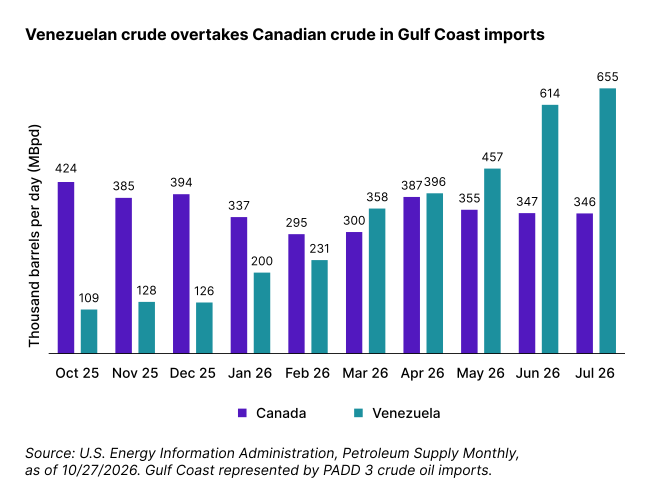
Venezuela’s return as a major crude supplier to the U.S. is reshaping the market for heavy crude. Venezuelan barrels have overtaken Canadian crude in Gulf Coast imports and, along with record freight costs, have pushed Canada’s heavy crude discount to more than double its 2025 levels. In response, Canada is accelerating its push into Asian markets. For midstream, long-term contracts and steady flows to the U.S. Midwest have limited the impact, while rising Canadian production continues to support new pipeline capacity.
Key takeaways
- Venezuelan crude has overtaken Canadian crude in U.S. Gulf Coast imports. Barrels that once went to China are now heading to U.S. refiners.
- The price discount in Canadian heavy crude relative to U.S. oil has more than doubled from 2025 levels. More competition and record shipping costs are the main drivers.
- Canada is shipping more crude to Asia. Long-term contracts have largely protected Canadian pipeline companies. Customers are still signing up for new pipeline capacity.
Venezuela’s return intensifies competition for heavy barrels
Since the U.S. captured Nicolas Maduro in January, Venezuela has steadily rebuilt its oil output and deepened its energy ties with Washington. Venezuelan production was estimated at 1.15 million barrels per day (MMBpd) in September, up about 19% from a year earlier. Under a 25-year agreement with the U.S. signed in August, Venezuela aims to lift output from 17 strategic fields to more than 1.5 MMBpd, up from about 0.2 MMBpd today.
Increasingly, those barrels are headed to the U.S. Gulf Coast. Last year, roughly three-quarters of Venezuela’s oil exports went to China. Since the U.S. lifted its naval blockade and eased sanctions, much of that supply has been redirected to the U.S. Gulf Coast, where refineries are configured to process heavy, sour crude. Valero (VLO) recently noted that Venezuelan crude competed “very favorably” against other heavy sour options in the third quarter, helping it set a record for Venezuelan runs. Similarly, Phillips 66 (PSX) said in August it had become the third-largest buyer of Venezuelan crude worldwide, and Marathon (MPC) more than doubled its Venezuelan runs in the second quarter.
Venezuela is reclaiming a role it once held. As recently as 2017, Venezuela was the Gulf Coast’s largest source of imported crude, before U.S. sanctions cut off those flows. Canada had since taken the top spot, leading Mexico in both 2024 and 2025. Now Venezuelan barrels are filling gaps left by other traditional suppliers. Mexico is keeping more of its heavy crude for its new Olmeca refinery, and after the Strait of Hormuz closed, Gulf Coast imports from Saudi Arabia fell from about 300 thousand barrels per day (MBpd) in the first quarter to zero by July. As shown below, Venezuelan imports to the Gulf Coast surpassed Canadian imports in April, and by July they were nearly double.