U.S. natural gas liquids (NGL) exports are now projected to grow by more than 10% this year, driven largely by international buyers looking to replace disrupted Middle Eastern supplies. As the U.S. and Canada cement their status as reliable energy suppliers, momentum for exports is increasing on top of steadily growing baseline demand for clean fuels and petrochemical feedstocks. To meet this heightened international appetite, midstream operators are maximizing throughput at existing marine docks and advancing a new wave of export terminals, positioning energy infrastructure companies to capitalize on a long-term shift in global trade.
NGLs and the role of North America in the global market
NGLs are produced at the wellhead alongside oil and raw natural gas. Processing plants initially separate mixed NGLs from dry natural gas (methane) before transporting the stream to fractionation facilities, where it is broken down into separate purity products: ethane, propane, butane (including isobutane), and natural gasoline. These NGL products each have their own distinct demand drivers, as discussed below.
The U.S. is by far the largest NGL producer in the world, accounting for ~49% of global production or 6.9 million barrels per day (MMBpd) in 2024. Its market dominance is anchored in liquids-rich shale plays, particularly the Permian Basin, which is responsible for ~85% of total U.S. liquid hydrocarbon growth. While the basin is primarily known for its oil output, production is getting gassier. Natural gas and NGL production are expected to grow faster than Permian oil volumes for the foreseeable future. Canada adds another 0.8 MMBpd of NGL production, representing ~5% of global supply.
Understanding the global demand for NGLs
Driven by a cost advantage and rising global demand for plastics and cleaner-burning fuels, U.S. exports have expanded rapidly over the past decade. As shown below, robust global demand has transformed U.S. NGL exports into a multiyear growth story across all major purity products.
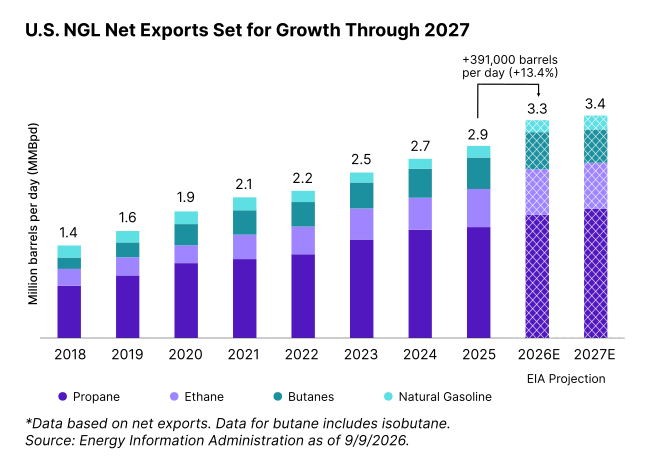
International export demand is shaped by the applications of each purity product. Ethane serves as the primary feedstock for steam crackers to produce ethylene, a key building block for global plastics and industrial manufacturing. China historically receives roughly half of all U.S. ethane exports, a trade anchored by Energy Transfer’s (ET) long-term agreement to supply Satellite Chemical with 150 MBpd (~51% of U.S. ethane sent to China in 2025). Robust demand from Chinese facilities, alongside new cracking capacity in Europe, Latin America, and the rest of Asia, provides a steady baseline for U.S. ethane export growth.
Propane makes up the largest share of exports and is used both as a cooking/heating fuel and a petrochemical feedstock. Although shipments to traditional top buyers like China and South Korea declined in 2025, largely due to tariffs, these drops were more than offset by surging demand from other Asian countries, where expanding populations and clean-energy policies are accelerating the transition away from wood and coal.
Meanwhile, butane serves as a chemical feedstock, a winter gasoline blendstock, and a subsidized cooking fuel in emerging economies. Finally, natural gasoline functions primarily as a blendstock and heavy-oil diluent, with nearly all U.S. natural gasoline exports moving directly to Canada by pipelines owned by Pembina (PPL CN) and Enbridge (ENB CN).
Since propane and butane share similar cooking and heating applications, they are frequently traded together in the global market as Liquefied Petroleum Gas (LPG). Driven by international demand, the U.S. holds approximately 57% of global waterborne LPG exports in the first half of 2026, up from 46% in 2024 and just 29% in 2016.
Middle East disruptions accelerate demand growth for U.S. exports
Though U.S. NGL exports were already expected to grow this year, the Iran war that began in March has reinforced the strategic value of U.S. supply. With Middle Eastern exports disrupted, European and Asian buyers have looked increasingly to the U.S. for NGLs. Since the war began, forecasts for U.S. NGL exports for 2026 have increased by almost 120 MBpd, or 3.7%, while estimates for 2027 exports have also edged higher.
Within U.S. midstream, ET, Enterprise Products Partners (EPD), and Targa Resources (TRGP) operate NGL export capacity, generating fees by loading ships. EPD recently highlighted in its second-quarter earnings call that the company is seeing rising interest from countries historically dependent on supplies from the Middle East. EPD saw its NGL marine terminal volumes average 1.07 MMBpd in the trailing 12 months ending 2Q26, a ~10% or 0.1 MMBpd, increase from 2025 volumes. TRGP cited record LPG export volumes as a key driver of its 2Q26 earnings beat.
The next wave of U.S. and Canadian NGL export infrastructure
A wave of NGL export projects is set to add substantial capacity in the U.S. and Canada over the next few years. The U.S. Gulf Coast remains a crucial export center, given its proximity to the Mont Belvieu NGL hub, which is largely fed by the Permian. In May, EPD completed the Phase 2 expansion of its Neches River Terminal, which added 180 MBpd of ethane or 360 MBpd of propane capacity. EPD plans to bring 300 MBpd of expanded LPG capacity online at its Enterprise Hydrocarbons Terminal in 4Q26.
By mid-2027, ET’s Marcus Hook Terminal in Pennsylvania is expected to add 20 MBpd of ethane capacity. TRGP anticipates bringing its 133-MBpd LPG expansion online in 3Q27. Meanwhile, new entrants MPLX (MPLX) and ONEOK (OKE) are jointly constructing a 400-MBpd LPG export terminal at Texas City, with an early 2028 startup.
ET’s recently announced Nederland expansion, fully subscribed under long-term contracts extending into the 2040s, represents the largest ethane capacity addition on the horizon, adding 240 MBpd of ethane capacity and 55 MBpd of LPG capacity. The project is expected to be placed into service in stages beginning in 2028, followed by the anticipated completion of two additional ship docks in mid-2029.
U.S. and Canadian NGL export capacity to grow 1.3 MMBpd by 2029
| Project | Owner | Product | Capacity (MBpd) | Target FID | Location |
| EHT LPG Export Expansion | Enterprise Products (EPD) | LPG | 300 | 4Q26 | Houston Ship Channel, TX |
| REEF Phase I | AltaGas (ALA CN) | LPG | 56 | 1Q27 | Prince Rupert, BC |
| Marcus Hook Terminal Optimization | Energy Transfer (ET) | Ethane | 20 | Mid-2027 | Marcus Hook, PA |
| GPMT LPG Expansion | Targa Resources (TRGP) | LPG | 133 | 3Q27 | Galena Park (TX) |
| REEF Optimization I | AltaGas (ALA CN) | Propane | 30 | 2H27 | Prince Rupert, BC |
| Texas City LPG Export | ONEOK (OKE)/MPLX (MPLX) | LPG | 400 | Early 2028 | Texas City, TX |
| ACE Rail Terminal | Keyera (KEY CN) | LPG | 45 | Mid-2028 | Fort Saskatchewan, AB |
| Nederland Ethane & LPG Expansion | Energy Transfer (ET) | Ethane & LPG | 240 Ethane, 55 LPG | 2028 (staged) | Nederland, TX |
Source: Company reports as of 10/1/2026
Finally, Canada is rapidly developing infrastructure on its West Coast to capture a share of the growing trans-Pacific NGL trade. Keyera’s (KEY CN) ACE Rail Terminal will link Fort Saskatchewan to tidewater, backstopped by take-or-pay contracts to deliver 45 MBpd of LPG capacity by mid-2028. AltaGas (ALA CN) is also constructing two projects, which will add 56 MBpd of LPG capacity in early 2027 and another 30 MBpd of propane capacity in 2H27. By year end, ALA plans to sanction another expansion of ~60 MBpd of LPG capacity (excluded from table above).
Ways to gain exposure
Global demand for NGLs provides a multiyear growth opportunity for energy infrastructure companies. Importantly, companies are not just operating the export terminals, but often own integrated systems that begin at producing wells, include processing facilities and pipelines, and ultimately end at coastal export facilities. Companies generate fees along this NGL value chain.
The key NGL export operators — EPD, ET, TRGP, OKE, and MPLX — are all constituents of the Alerian Midstream Energy Select Index (AMEI), which is approximately 75% U.S. and Canadian midstream corporations and 25% MLPs. The MLPs among them (EPD, ET, and MPLX) are top constituents of the Alerian MLP Infrastructure Index (AMZI). AMZI was yielding 6.9% and AMEI was yielding 4.6% as of September 30.
For an overview on how the energy infrastructure space has evolved over the past decade, watch the replay of our recent webcast, “A Decade of Evolution: What’s Changed in the Midstream Space?”
Key takeaways
- The U.S. dominates global NGL production through liquids-rich shale plays. Distinct demand drivers for purity products like ethane and propane continue to power long-term export growth.
- Middle East supply disruptions are boosting global demand for North American NGLs, and exports are now expected to grow by more than 10% this year.
- Midstream companies are expanding export terminals in the U.S. and Western Canada, which will add substantial export capacity through 2029.
AMZI is the underlying index for the Alerian MLP ETF (AMLP) and the ETRACS Alerian MLP Infrastructure Index ETN Series B (MLPB). AMEI is the underlying index for the Alerian Energy Infrastructure ETF (ENFR) and the Alerian Energy Infrastructure Portfolio (ALEFX).
Related research:
Midstream Scales Up Natural Gas Infrastructure
Global Shocks Accelerate North American LNG Growth
U.S. Oil Production Outlook & Midstream Implications
Revisiting Energy Market Impacts From the Iran War
Permian Powers Midstream Growth From Well to Water
vettafi.com is owned by VettaFi LLC (“VettaFi”). VettaFi is the index provider for AMLP, MLPB, ENFR, and ALEFX, for which it receives an index licensing fee. However, AMLP, MLPB, ENFR, and ALEFX are not issued, sponsored, endorsed or sold by VettaFi, and VettaFi has no obligation or liability in connection with the issuance, administration, marketing or trading of AMLP, MLPB, ENFR, and ALEFX.