The United States is the world’s largest spender on defense, allocating more than the next six countries combined. On paper in 2025 the U.S. saw its bottom-line figure decline, absent new military spending for Ukraine. But the U.S. Congress approved a $1 trillion budget for 2026 and is requesting a record $1.5 trillion for 2027, representing a massive 40%+ increase.
Key takeaways
- The U.S. is the world’s top defense spender, spending more on defense than the next six countries combined.
- Record spending reflects not only a more offensive posture, but a commitment to global technological dominance.
- The future of U.S. defense will be dictated by technologies like AI, autonomous platforms, drones, and next-generation and quantum computing.
The United States spends more on defense than the next 6 countries combined
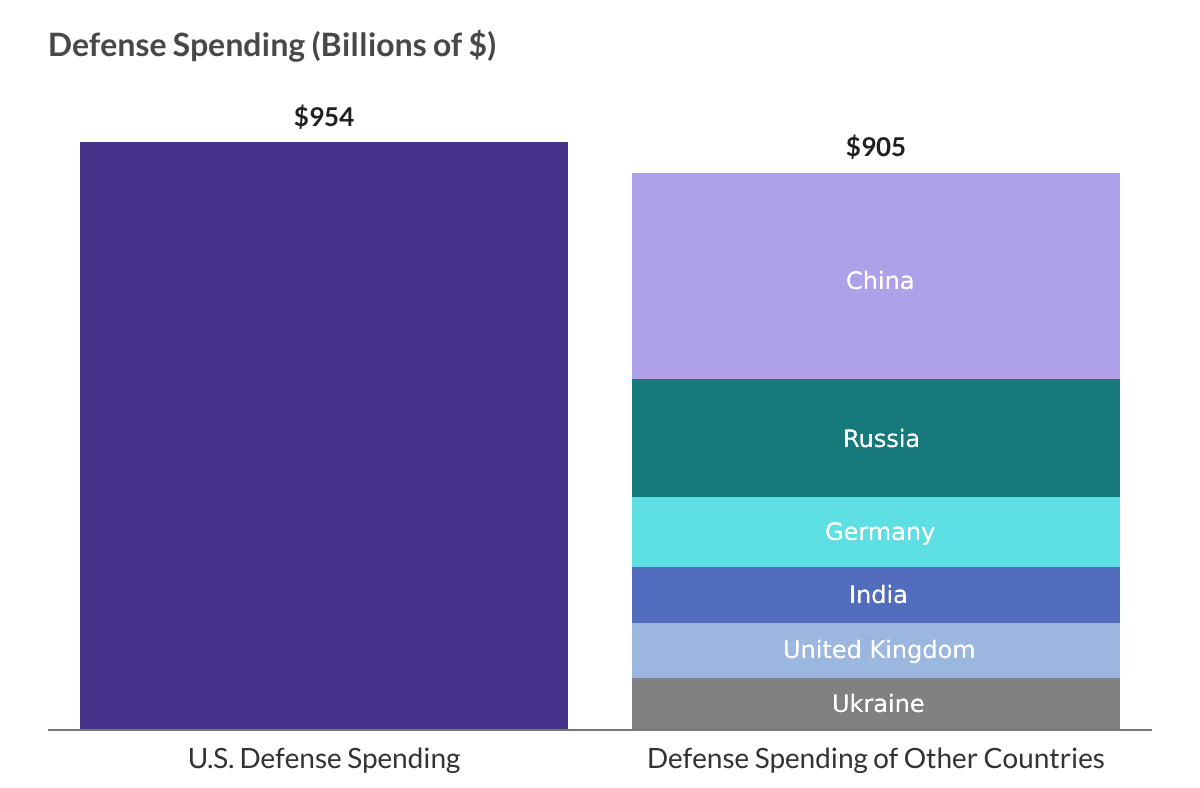
Source: Stockholm International Peace Research Institute; Chart: Peter G. Peterson Foundation
Notes: Figures are in U.S. dollars converted from local currencies using market exchange rates. Data for the United States are for fiscal year 2025. Data for the other countries are for calendar year 2025. The source for this chart uses a definition of defense spending that is more broad than budget function 050 and defense discetionary spending referenced by the Congressional Budget Office.
Future of defense spending
In September of 2025, the name of the U.S. Department of Defense was changed by executive order to the Department of War. The U.S. originally established its military leadership as the Department of War in 1789 under General George Washington. The department was later rebranded as the Department of Defense under President Harry S.Truman.
One of the stated reasons for the name change was a shift to a more offensive defense posture, and this has played out first with the U.S. invasion of Venezuela and the attack on Iran. But another key element of the U.S. defense strategy is a heightened emphasis on the future of defense technologies such as AI, cyber defense, robotics, and drones.
The U.S. leads in advanced weaponry, space-based intelligence, stealth aviation, and autonomous systems, funded by a 71% increase in procurement and R&D allocations.
-
Artificial intelligence: The Department of Defense has integrated advanced AI systems into its classified networks. Landmark contracts with tech leaders like OpenAI, Google, Microsoft, and SpaceX ensure real-time data synthesis and augment warfighter decision-making.
-
Autonomous platforms: The rise of autonomous defense deep-tech — such as Palantir, Shield AI and Anduril Industries — has shifted the battlefield, giving the US an advantage in unmanned drones and software-defined warfare.
-
Next-gen computing & quantum: U.S. defence is heavily invested in quantum computing capabilities and sensors to secure communications and maintain intelligence advantages over strategic competitors.
U.S. Department of Defense technology spending: 2020 vs 2026
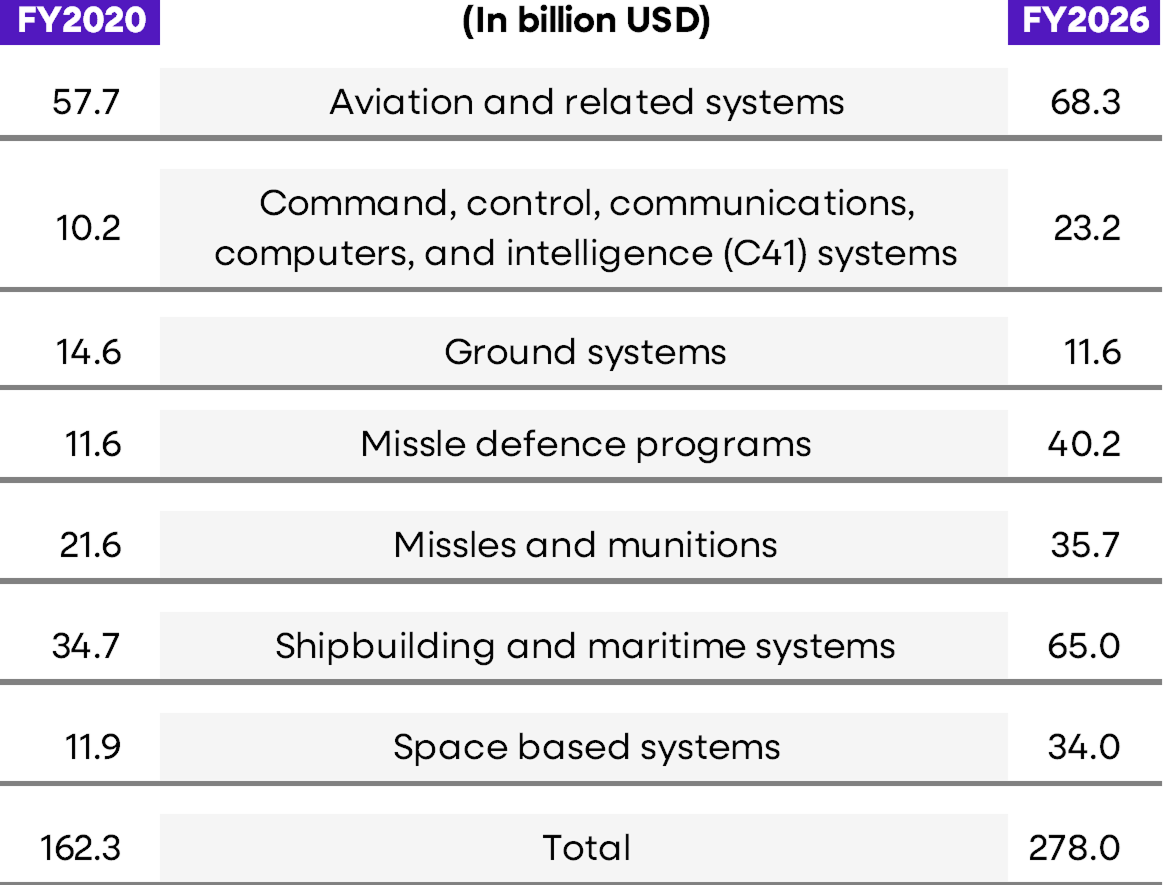
Source: Strategic Research Institute
2027 budget plan for $1.5 trillion in spending
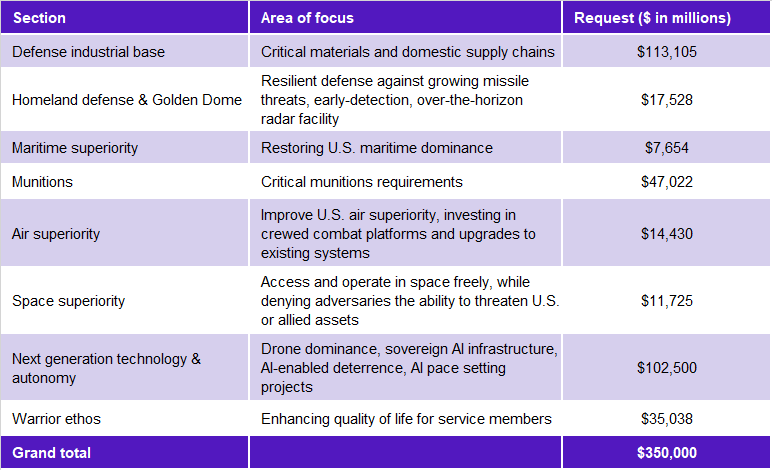
The U.S.’s proposed defense budget of $1.5 trillion represents the country’s largest investment in defense since World War II. The budget consists of $1.15 trillion in discretionary spending and $350 billion in mandatory funding. Highlighting some of the key areas of spending depicted in the table below, it includes special initiatives such as the “Golden Dome for America” missile defense shield program, part of the $17.5 billion allocation to homeland defense. There is also a 42% budget increase aimed at “supercharging” the defense industrial base, such as critical materials and domestic supply chains. And there is a $102.5 billion allocation to next generation technology and autonomy which includes the $54.6 billion “Drone Dominance” program and of course, investments in AI.
$350 billion in mandatory funding by section
As modern conflicts like the war in Ukraine and Iran have demonstrated, technological innovation has become crucial to military success. Technology is becoming a rising part of the investment thesis and catalyst for growth for the future of defense.
Our index approach
The VettaFi American Future of Defence Index (USDFS) tracks the market performance of U.S. companies, listed on U.S. exchanges that provide exposure to NATO defense and cyber-defense spending.
Constituents must be U.S.-listed equities of companies headquartered or domiciled in the U.S. Index components must derive more than 50% of their revenues from the manufacture and development of military aircraft and/or defense equipment (military armored vehicles and tanks, weapon systems and missiles, munitions and accessories, electronics and mission systems, and naval ships), defense technology applications, or cyber security contracting with a NATO member nation verified by publicly available contract information. The top 50 companies that meet the index criteria are free float market-cap weighted.
For more detailed information about the VettaFi American Future of Defence Index (USDFS), click here. The index has been licensed by HANetf in Europe as the Future of US Defence UCITS ETF (GIJO).