AI Photonics is the integration of light-based technologies (photonics) into artificial intelligence hardware to transmit data and perform calculations. By replacing traditional electrical copper connections with photons, AI Photonics overcomes the severe bandwidth, latency, and power consumption bottlenecks that currently limit the scaling of massive AI data centers.
Key takeaways
- Photonics, the science and technology of manipulating light, uses light (photons) instead of electricity (electrons) to transfer data.
- Moving data almost at the “speed of light,” photonics accelerates the process of AI training and inference by enabling ultra-high-speed bandwidth, lower latency, and massively parallel data transfer.
- Photonic processing also significantly reduces the massive heat and energy consumption required using traditional electronic hardware.
Why AI needs photonics
As AI models have become exponentially larger and more complex, traditional electronic chips (CPUs and GPUs) have struggled with two key bottlenecks:
-
-
The speed of data transfer, and
-
Thermal and power constraints.
-
The bottleneck solution for AI is photonics, replacing copper wires with photons traveling through glass fibers.
At Computex 2026, Nvidia CEO Jensen Huang explained it like this:
Copper has its limits with bandwidth and distance... Scale up with copper as long as you can. After that, you scale up further with optics.1
Photonics helps overcomes AI’s bottlenecks in three key ways2:
-
-
Ultra-fast data transfer (optical interconnects): Copper wires heat up and restrict how fast data can travel between computing nodes. Photonics allows information to travel via light, transmitting hundreds of terabits per second. Technologies like co-packaged optics (CPO) allow fiber optic cables to connect directly to processors, helping relieve a major bottleneck of AI.
-
Greater energy efficiency: Data center power consumption is soaring due to AI processing and cooling. Because light particles generate almost no heat when they travel, photonic AI systems require significantly less cooling and electrical power than traditional silicon setups.
-
Massive parallel processing: Photonic circuits can process different wavelengths of light simultaneously. This is called Wavelength Division Multiplexing (WDM). WDM allows multiple layers of AI calculations to occur at the same time at lightning speed.
-
AI photonics: The need for light speed
According to NASA, in a vacuum, light can travel at a maximum speed of 300,000 kilometers per second (the speed of light)3. To put this in perspective, a traveler, moving at the speed of light, would circumnavigate the globe approximately 7.5 times in one second.
Using photonics, data cannot quite travel at the speed of light. However, photons, unlike electrons, do not experience electrical resistance, do not generate the same thermal heat, and do not suffer from electromagnetic interference or crosstalk. This allows massive streams of data to move concurrently and more efficiently at rapid speed.4
Data center connections have evolved from 100 Gbps (gigabits per second) back in 2015 to 800 Gbps today. Enabled by photonics, they are moving toward one of the biggest speed transitions ever, to 1,600 Gbps (1.6T) scale this year.
How fast data moves: The speed keeps doubling
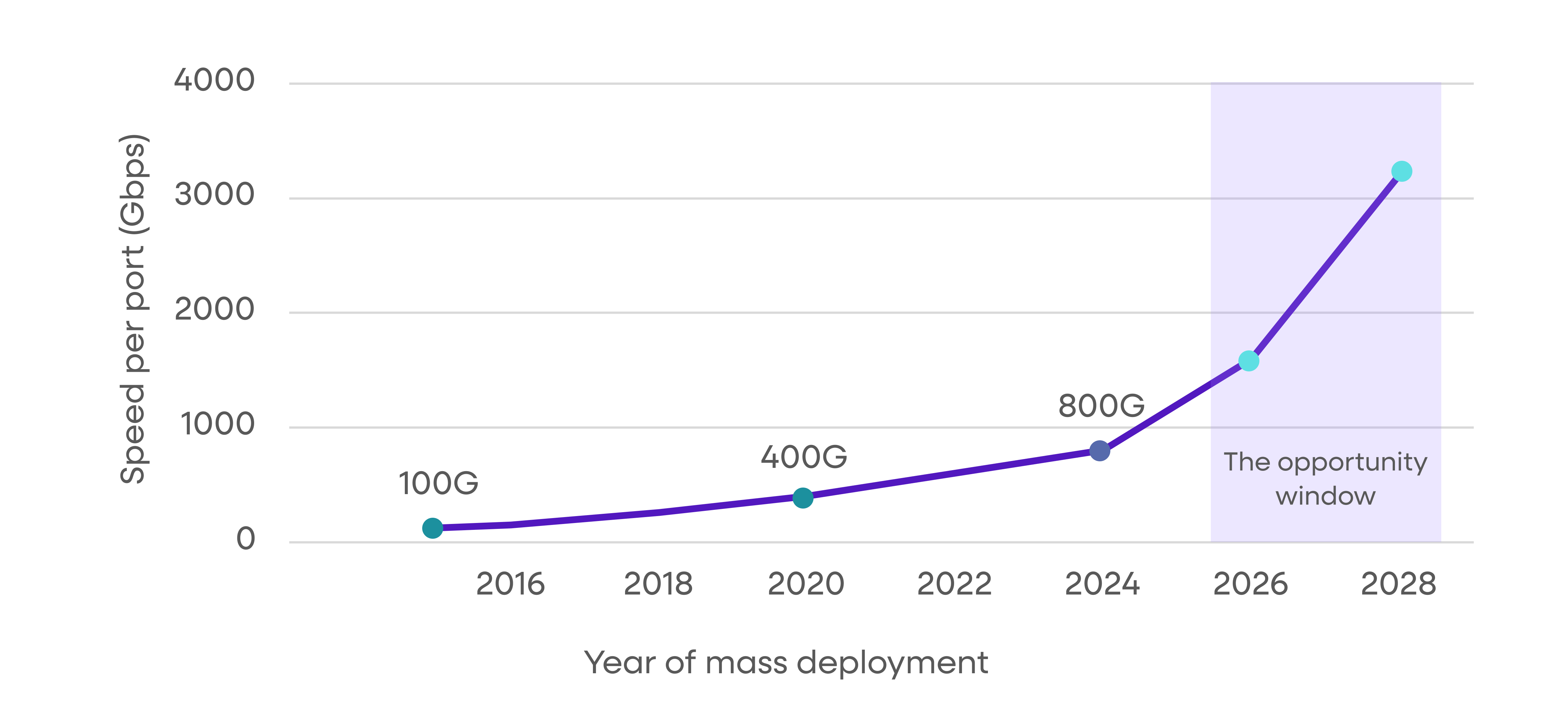
Source: Zourmpanos, Yiannis, The Photonics Boom: A Simple Guide to the Biggest Investment Theme in 2026.
Photonics 101
Optics is a branch of physics which studies the behaviors and properties of light. Practical applications of optics include mirrors, telescopes, lenses, lasers, and fiber optics.
Photonics is a branch of optical science that involves the generation, detection, and manipulation of light particles called photons. This can be done by emission, transmission, modulation, switching, amplification, signal processing, and sensing.5
Photonic technology is not new. In fact, it was utilized in many other applications before AI, such as:
-
Consumer electronics: barcode scanners and remote controls;
-
Renewable energy: photovoltaics for solar;
-
Telecommunications: fiber optic cables;
-
Sensors: LIDAR for autonomous vehicles; and
-
Medical: laser surgery.
The manufacturing of photonic chips involves creating photonic integrated circuits (PICs) that use light (photons) instead of electrons for data processing.
Photonic integrated circuit (PIC)6
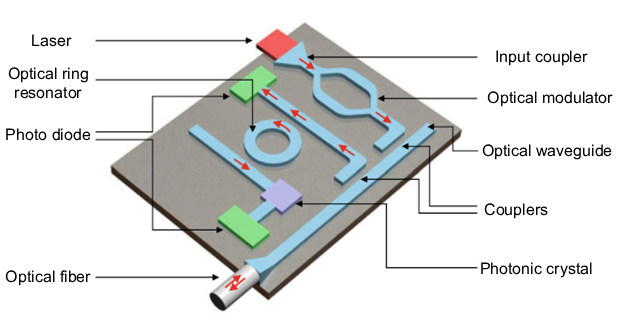
The photonic chip fabrication process requires specialized raw materials such as silicon (Si), indium phosphide (InP), silicon nitride (SiN), gallium arsenide (GaAs), and lithium niobate (LiNbOâ,f), along with precise fabrication techniques such as lithography, etching, and deposition.7
Growing investment in photonics
According to Grand View Research, the global photonics industry reached a total market value of over $1 trillion in 2026, bolstered by a surge in corporate, venture capital, and government funding to solve critical AI bottlenecks.
Light moves faster, carries more data, and uses less electricity. So it is no wonder that companies like Google, Nvidia, Microsoft, Meta, and Amazon are spending billions to switch from copper to photonics (light) technology.
Nvidia alone has committed $6.5 billion this year to companies developing photonics technology, announcing $2 billion in investments into Lumentum, Coherent, and Marvell, all of which are involved in photonics technology. The chip giant also invested $500 million into Corning to develop advanced optical connectivity solutions. Nvidia also participated in optics startup Ayar Labs’ $500 million Series E funding round.9
Quantum photonics
Photonics also offers a major breakthrough for quantum computing, due to its room-temperature operational capabilities. Unlike superconducting systems that create the need for cryogenic cooling, photonic solutions can function without extreme cold.10
Major quantum and semiconductor companies investing in or developing quantum photonics include PsiQuantum, Photonic Inc., GlobalFoundries, and new IPO Quantinuum. These firms are using light-based optical circuits and silicon spin qubits to build fault-tolerant quantum systems at scale without the need for cryogenic cooling.11 The U.S. government recently announced a $2 billion investment in quantum computing via the CHIPS and Science Act, some of which will also be applied to quantum photonic solutions.12
China’s hedge against export controls
The global appeal of photonics has been further confirmed by a growing interest and investment in China. China has launched several new initiatives in an effort to advance the country’s AI capabilities against the backdrop of U.S.-imposed semiconductor restrictions.13
In June 2026, China launched the Shanghai Key Laboratory of Integrated Photonic Computing Chips. The lab is a joint venture between Shanghai Jiao Tong University and Shanghai-based Lightelligence, one of the country’s leading photonic computing startups, which recently listed on the Hong Kong exchange to a 380% IPO debut. The lab aligns with China’s broader goal for AI technological self-reliance. Photonics technology could help Chinese engineers navigate AI compute bottlenecks by building on the country’s existing strengths in fiber optics and laser technology.14
Our index approach
The VettaFi AI Photonics Index (AIPHTN) measures the performance of companies engaged in AI photonics. The index is composed of the top 25 global companies by engagement and market-cap classified within the AI Photonics Index’s six-layer stack architecture.
| Layer | Name | Description | Stock Examples |
| 1 |
The soil |
Foundational chemical compounds (indium phosphide), specialized wafers, and next-generation polymers. | Land Mark Optoelectronics, Lightwave Logic |
| 2 | The bulbs & lenses (raw light & micro-optics) |
Physical hardware that generates, steers, and catches the light (laser diodes, photodetectors, lenses). | Lumentum Holdings, Coherent |
| 3 | The brains (translators & optical intelligence) |
Semiconductor chips bridging electrical/optical; includes analog drivers and optical DSPs. | Credo Technology, Broadcom |
| 4 | The builders (final module integration & assembly) |
Robotic assembly of chips, lasers, and lenses into transceiver modules or CPOs. | Zhongji Innolight Co Ltd., Fabrinet |
| 5 | The infrastructure (The physical highway & network) |
Physical routing systems like Ethernet switches, glass fiber-optic cabling, and long-haul systems. | Amphenol, Arista Networks |
| 6 | The inspectors (toolmakers & quality control) |
Lab testing equipment, validation platforms, and precision alignment tools for flaw detection. | Aixtron |
Given the favorable growth dynamics for photonics in China amid U.S. export controls, there is a significant allocation (34%, as of June 30, 2026) to China photonics names in the index.
For more information about the index, visit VettaFi.com. The VettaFi AI Photonics Index (AIPHTN) has been licensed in the U.S. by Aura ETFs as the Aura AI Photonics ETF (PHOX) in partnership with Tidal ETFs. The index is available for additional licensing in other markets and for other product types.
-
Jensen Huang Just Explained the Entire Silicon Photonics Investment Thesis in One Minute, June 6, 2026, moomoo.com, https://www.moomoo.com/community/feed/jensen-huang-just-explained-the-entire-silicon-photonics-investment-thesis-116706582069254
-
AI Desperately Needs Photonics, Photonics21 and TEMATYS, https://www.photonics21.org/download/news/2025/Photonics_for_AI_final.pdf, Brussels/Düsseldorf/Paris 2025.
-
How Fast is the Speed of Light?, NASA.gov, https://www.grc.nasa.gov/www/k-12/Numbers/Math/Mathematical_Thinking/how_fast_is_the_speed.htm
-
How Fast are Photonic Chips, PhotonDelta, https://www.photondelta.com/blog/how-fast-are-photonic-chips/, February 2026.
-
Apollo Optical Systems, https://www.apollooptical.com/blog/what-is-the-difference-between-optics-and-photonics
-
Ovaga.com, https://www.ovaga.com/blog/transistor/photonic-integrated-circuit-definition-disadvantage-fabrication-application
-
Laskey, Robyn, How are photonic chips manufactured?, PhotonDelta, January 5, 2026.
-
Grand View Research, Photonics Market, 2025 -2030, https://www.grandviewresearch.com/industry-analysis/photonics-market
-
Nicol, Schwartz, Kai, Nvidia is investing billions into this emerging technology that could change the AI industry, CNBC, May 29, 2026, https://www.cnbc.com/2026/05/29/nvidia-photonics-investment-ai.html?__source=iosappshare%7Ccom.apple.UIKit.activity.Mail
-
James, Diana, Photonics and Quantum Computing: A Radiant Revolution, IEEE Computer Society, December 19, 2024.
-
PsiQuantum, Silicon photonics, https://www.psiquantum.com/
-
Department of Commerce Announces Letters of Intent With 9 Companies for $2 Billion to Accelerate U.S. Leadership in Quantum Computing, NIST, May 21, 2026, https://www.nist.gov/news-events/news/2026/05/department-commerce-announces-letters-intent-9-companies-2-billion
-
What Is Photonics, and Why Is This Emerging Technology Attracting Billions of Dollars of New Investment?, International Banker, July 25, 2026, https://internationalbanker.com/technology/what-is-photonics-and-why-is-this-emerging-technology-attracting-billions-of-dollars-of-new-investment/
-
China opens its first photonic computing lab as it bets on light to outrun US chip curbs, TNW, June 12, 2026, https://thenextweb.com/news/china-photonics-lab-ai-chips-us-curbs