According to a new study by PwC, global spending on AI infrastructure is expected to reach a massive $31.6 trillion through 2050. Annual spending is on track to rise from $800 billion this year and accelerate to $1.8 trillion by 2050.1
Unlike other infrastructure buildouts, which have an initial construction phase that peaks and then tapers out, AI models are becoming exponentially larger and more complex over time. As a result, the AI boom is expected to be a recurring multi-decade cycle, with servers, GPUs, and other equipment needing to be refreshed every four to six years.
So where should investors look to invest to capitalize on the AI investment boom?
Key takeaways
-
Hyperscalers such as Amazon, Alphabet, Meta, Microsoft, and Oracle are writing the check for chips, data centers, and power.
-
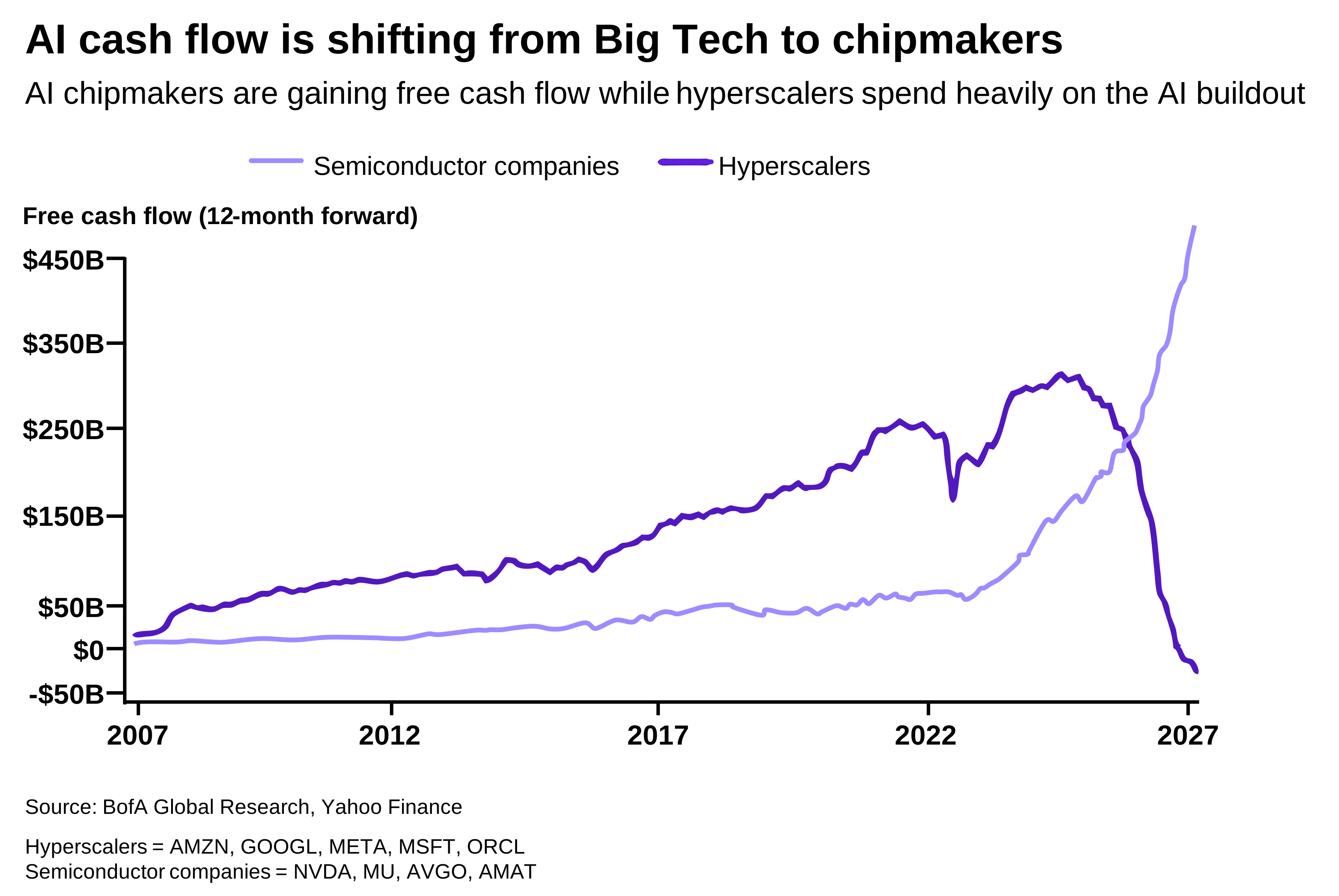
Cash flows are shifting away from Big Tech spending heavily to fund the AI buildout, and AI chipmakers are on the receiving end.
-
Bank of America Global Research is calling this massive shift in corporate capital a “generational transfer in free cash flow.”2
-
The chipmakers are in the driver’s seat with regard to pricing power and profit margins, as supply cannot keep pace with the voracious appetite.
As depicted in the chart below, corporate cash flows are moving in opposite directions as Big Tech hyperscaler capex spending rises and money flows to chipmakers such as Nvidia, Micron, Broadcom, and Applied Materials.
Investment case for AI chipmakers
The investment case for AI chipmakers is fortified by this “generational transfer in free cash flow”. While tech giants spend heavily and are increasingly issuing debt to fund the AI buildout, chipmakers are accumulating cash at the base of the technology stack, providing semiconductor chips, manufacturing, and design.
While the first phase of the AI buildout was able to be funded by hyperscalers’ operating cash flow, the scale of the undertaking now requires multiple funding sources. The days of the capital-light model are over, with hyperscalers raising debt across multiple currencies, maturities, and financing structures. JP Morgan estimates that hyperscalers will issue USD 300 billion in investment-grade debt this year.3
Big tech’s expansive appetite is expected to deploy more than $700 billion in capex in 2026 for AI infrastructure.4 Increasingly, chip manufacturing has become an obstacle to the pace of the AI compute buildout as supply cannot keep pace with demand. This is particularly the case for high-bandwidth memory (HBM) and advanced logic chips, but demand has also spread to the need for conventional DRAM, NAND flash, and memory storage.
Chipmakers are in the driver’s seat with regard to pricing power and profit margins, as supply cannot keep pace with the voracious AI appetite. New manufacturing capacity takes years to complete, requiring more than a decade before generating considerable commercial output. As a result, experts project that the AI memory market will remain tight for the foreseeable future, despite new investments in manufacturing capability.5
A diversified value chain
Another factor in favor of chipmaker exposure is its diversity across the AI value chain. The AI investment opportunity spans multiple use cases across the AI workload. As visualized in the image below, training, inference, retrieval, augmented generation, and agentic AI all place different demands on the memory stack.

Created with Google Gemini
Our index approach
The VettaFi AI Chip Manufacturing Index (CHIP) provides exposure to the global companies driving the physical backbone of the artificial intelligence (AI) boom. It monitors the stock performance of businesses essential to the chip manufacturing process, specifically targeting three critical sectors:
-
-
Wafer Fabrication Equipment: the machinery used to build the foundational silicon (or “wafer”) used in AI chipmaking.
-
Advanced Packaging: the high-tech semiconductor assembly required to achieve the function, performance, and power gains required for complex AI architectures.
-
Metrology: the precision testing and measurement used in the AI chip manufacturing process for advanced chip yields.
-
The index is float-modified market cap weighted within each segment, and the following weights are applied to each segment:
50% - Wafer Fabrication Equipment
25% - Advanced Packaging
25% - Metrology
For more information about the index, visit VettaFi.com.
The VettaFi AI Chip Manufacturing Index (CHIP) has been licensed in the US by REXShares as the REX AI Chipmaking ETF (CHIP), and is expected to launch on September 23, 2026. The Index is available for additional licensing in other markets and for other product types.