The first piece of this series examined how legacy bond benchmarks carry design choices from a market that no longer exists. The second showed how equal weighting breaks the link between debt issuance and portfolio weight. This final piece asks what those foundations make possible. What can a well-built index do that a legacy benchmark cannot?
Quite a lot, it turns out. A sound foundation becomes a platform for removing unintentional bets and expressing investment ideas with discipline. The natural place to start is the outcome investors ask about most often, which is more yield.
The dispersion hiding inside every rating band
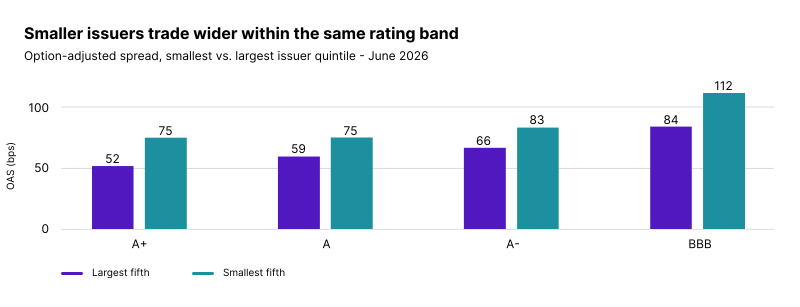
Investment grade credit has a well documented pattern. Defaults are rare, and the overwhelming majority of issuers pay their coupons and repay their principal year after year. Yet the market does not price them alike. Two companies within the same rating cohort can trade at meaningfully different spreads.
Some of that dispersion reflects genuine differences in credit. An issuer trading wide to its cohort can be on its way down, but not all of the difference is attributable to default risk. In the latest U.S. IG benchmark universe, the smallest issuers traded approximately 20bps wider than the largest across the A rating notches, and close to 30bps wider in BBB.
The point is not that every wide bond is mispriced. It is that wider spreads can be on offer within the same rating cohort, and the question is how to harvest the extra spread without giving up the discipline that made the index worth owning.
A screen, not a forecast
The traditional way to hunt for extra yield is to pick names and decide which wide spreads represent opportunity and which represent warning. That can be a true source of skill for an active manager, but it is too idiosyncratic for a rules based index. A well-designed index does not need to make such forecasts. It needs to be built on a robust structure and transparently define its risk reward tradeoff.
The VettaFi Enhanced Yield Index was created to test this hypothesis. The index applies a spread screen to determine index eligibility. Issuers are grouped into rating cohorts, and an issuer must offer sufficient spread relative to its peers to qualify. At the annual reconstitution, the hurdle adjusts with the live spread between BBB and A credit. When credit dispersion is wide, the hurdle becomes more demanding. When dispersion is tight, it relaxes.
The qualifying issuers are still equally weighted, guardrails still preserve the broad shape of the market, and duration stays closely aligned with the benchmark, so an interest rate bet is not being smuggled in. And because the framework operates at the issuer level, the index is designed to give managers the widest latitude in replication. The index decides which issuers belong, while bond by bond representation stays with the PM, the division of labor we described in the first piece.
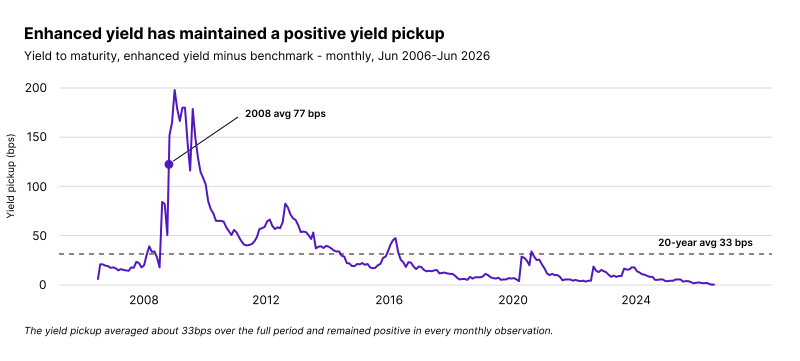
The result is a persistent yield advantage. Over 20 years, the Enhanced Yield Index offered about 33bps more yield than the benchmark on average, with a positive pickup in every monthly observation. The advantage expanded when credit markets offered more dispersion. In 2008, the pickup averaged more than 75bps. Today it is only a few basis points, reflecting much tighter market conditions. That is a feature of the design, not a failure to hit a target. The index seeks additional compensation when the market offers it rather than forcing a fixed yield objective by taking undue risk.
What is the catch?
Clients ask this, often in exactly those words. It deserves a straight answer. There are two costs.
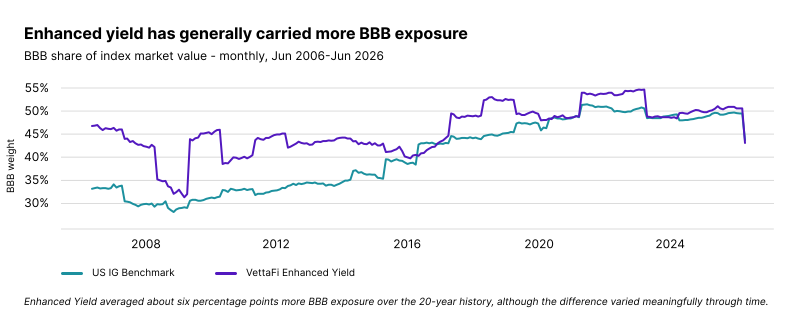
The first is credit exposure. Wider spreads are not free money, and some portion of what the screen collects is compensation for genuine incremental risk. Over its history, Enhanced Yield has carried roughly half a rating notch lower average credit quality than the broad benchmark and about six percentage points more BBB exposure.
The design constrains that exposure in advance. The screen operates within rating cohorts, limiting how far the portfolio can migrate down the quality spectrum, while equal weighting limits the damage any single issuer can do. It is the same principle — you win by not losing — that underpins the equal weight index. You do not need to predict every credit event if no single credit is allowed to determine the outcome.
The second cost is turnover. Enhanced Yield turns over roughly 77% one way per year against about 30% for the benchmark, and the gap is not spread evenly. The issuer screen is refreshed at the annual reconstitution, which accounts for more than 80% of the turnover the screen adds over the benchmark. In the months between reconstitutions the index trades at close to the benchmark’s own rate, because what remains is ordinary index maintenance rather than selection. That distinction matters, because a headline turnover number does not necessarily describe the trading burden managers face month after month.
What it delivers
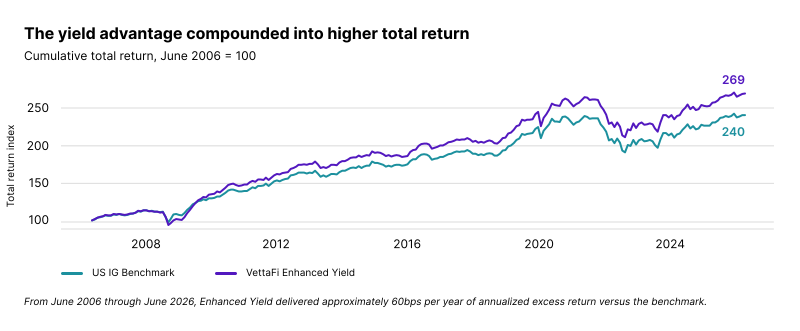
Over the full twenty year history, the higher yield and disciplined construction translated into approximately 60bps per year of annualized excess return versus the benchmark. The advantage was not delivered evenly. It tended to be stronger when credit dispersion was wider and more modest when spreads were compressed, which is consistent with a strategy designed to capture the compensation available in the market rather than manufacture the same outcome in every environment.
What a well-built index makes possible
A better benchmark starts by removing decisions that were never investment views in the first place. Which bonds represent an issuer should not be dictated by liquidity constraints from another era, and debt weighting is not an investment thesis. Once those inherited choices are stripped away, the index has a cleaner foundation built around representation, diversification, and deliberate risk taking.
That is the larger opportunity in modern index design. A well built index does more than describe the market and does not need to pretend it can forecast which issuers will win or lose. It creates a disciplined framework for expressing intentional investment ideas without allowing unintended risks to take over. With these structural improvements, the updated blueprint is now ready for the modern ETF wrapper.