Infrastructure debt is one of the most overlooked segments of public credit. The exposure is already present in broad corporate bond benchmarks, but it is scattered across sectors and issuers, making it difficult to size, analyze, or evaluate on its own terms. That matters because infrastructure credit is not just another slice of the corporate bond market. Many infrastructure issuers are backed by regulated grids, pipelines, rail networks, communications towers, water systems, and other hard assets with long economic lives, essential-service demand, and quasi-monopoly characteristics that few areas of credit can match.
The Global Listed Infrastructure Organisation VettaFi Bond Index, or GLIO Debt, gives investors a deliberate way to track this segment of the market. Compared with a broad investment-grade corporate benchmark, it has materially higher exposure to utilities and infrastructure issuers, far less exposure to financials, and currently offers more OAS per unit of duration. For bond investors, the question is not just how much OAS is available, but what assets, cash flows, and regulatory structures stand behind it.
| ~920 Issuers |
~90 Issuers |
6.2 yrs Duration |
4.9% Yield |
111 bps OAS |
BBB Avg Rating |
GLIO VettaFi Bond Index, June 2026. Largest geographic exposure in the Americas (71%)
What does GLIO debt track?
GLIO Debt tracks the public bonds of listed infrastructure companies, with a heavy concentration in investment-grade issuers tied to utilities, pipelines, and other essential-service infrastructure. The index holds roughly 920 issues from about 90 issuers, with its largest geographic exposure in the Americas.
.svg)
This exposure already exists within broad corporate bond benchmarks, but only in diluted form. In a typical investment-grade corporate index, utilities and infrastructure issuers sit alongside financials, technology, healthcare, consumer credits, and general industrials. The result is accidental exposure, not a deliberate allocation.
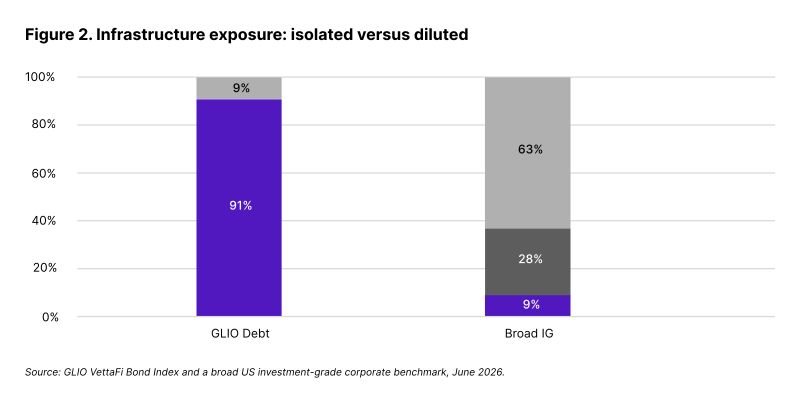
GLIO Debt is designed to make that exposure measurable. It isolates the fixed-income portion of listed infrastructure, giving investors access to long-lived, essential-service issuers through coupons and senior claims rather than equity ownership. That distinction starts with index construction. Many infrastructure bond indices rely on broad sector classifications, which can include companies only loosely tied to infrastructure.
GLIO Debt's issuer universe is drawn from the established Global Listed Infrastructure Organization framework, which focuses on companies that own and operate mission-critical infrastructure assets. The result is not a generic corporate bond index with an infrastructure label. It is a debt version of a vetted listed-infrastructure universe, designed to be less diluted, more intentional, and more closely tied to the durable cash flows that define the asset class.
The HALO framing: Heavy Assets, Low Obsolescence
Index construction is only part of the story. The deeper distinction is the nature of the assets behind the debt. Credit ratings focus primarily on default probability, but they do not fully capture asset durability, recovery value, or long-term business resilience. Two issuers can carry the same rating while being backed by very different assets and cash-flow profiles.
We frame this as a HALO profile, for Heavy Assets, Low Obsolescence. These are businesses built around physical networks that are difficult to replicate, expensive to replace, and essential to modern economies. Their assets often have useful lives measured in decades, and many earn regulated or contracted returns from quasi-monopoly positions.
That does not make the bonds risk-free. Investors in infrastructure debt still face regulatory lag, political risk, capital intensity, holding-company structures, and spread volatility. Those risks, however, differ from much of broad corporate credit. In GLIO Debt, the spread investors collect is tied less to product cycles or discretionary demand and more to the complexity of financing durable, essential-service assets.
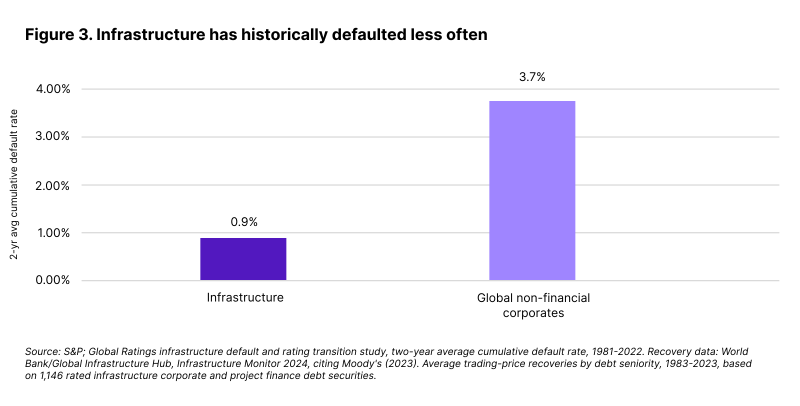
The data supports this distinction. S&P's infrastructure study found a two-year average cumulative default rate of 0.9% from 1981 to 2022, compared with 3.7% for global non-financial corporates. On recoveries, Moody's data in the World Bank's Infrastructure Monitor 2024 shows average trading-price recoveries of 61% for senior unsecured infrastructure debt, against 38% for senior unsecured corporate debt. Heavy assets with low obsolescence do not eliminate credit risk, but they can support a form of credit resilience that is often diluted inside broad corporate benchmarks.
Similar returns, more durable exposure
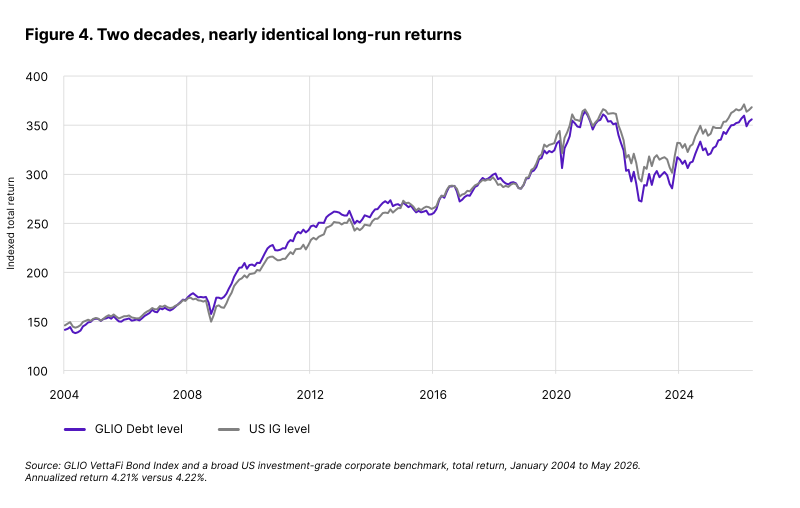
A clear view of the boundaries is part of an honest case. GLIO Debt is not designed to be a diversifier away from corporate bonds. It is long-duration, rate-sensitive corporate credit, with returns that have been highly correlated with broad investment-grade credit.
The distinction is not that GLIO Debt changes the basic return profile of investment-grade credit. Over more than two decades, GLIO Debt and broad investment-grade credit have produced virtually the same annualized return, 4.21% versus 4.22%. The difference is the exposure behind that return. GLIO Debt tracks corporate credit through a more deliberate concentration in essential-service issuers, durable cash flows, and long-lived physical assets.
That distinction is especially relevant as investors increasingly look to finance the latest wave of infrastructure buildout. The recent AI buildout has made AI-related infrastructure credit one of the most sought-after exposures in the market. The five largest hyperscalers issued $121 billion in US corporate bonds in 2025, against an average of $28 billion a year over 2020 to 2024, as the market races to finance the expansion of compute capacity. GLIO Debt offers a different expression of infrastructure credit, one less tied to rapid technological replacement and more anchored in physical networks with long operating lives.
The point is not that AI-related issuers are weak credits. Many are among the strongest borrowers in the corporate bond market. The difference lies in the assets being financed. AI infrastructure depends heavily on servers, GPUs, networking equipment, and data-center systems whose useful lives are measured in years and can be shortened by each new chip cycle. GLIO Debt, by contrast, is tied to physical infrastructure whose useful lives are commonly measured in decades.
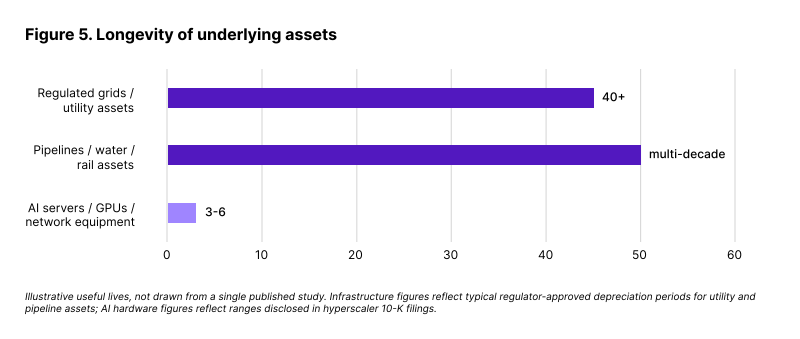
That asset-life gap matters for bond investors. In fast-moving technology infrastructure, economic value can depend on replacement cycles, utilization rates, power availability, and the pace of obsolescence. In traditional infrastructure, assets are harder to replicate, slower to become obsolete, and often supported by regulated or contracted cash flows. Both can belong in credit portfolios, but they expose bond investors to different kinds of infrastructure risk.
Infrastructure across the capital structure
Infrastructure debt can also complement infrastructure equity. Both exposures are linked to many of the same underlying assets, but they represent different claims on those assets. Equity provides participation in growth, earnings upside, and valuation expansion. Debt provides coupon income, seniority in the capital structure, and a different pattern of downside risk.
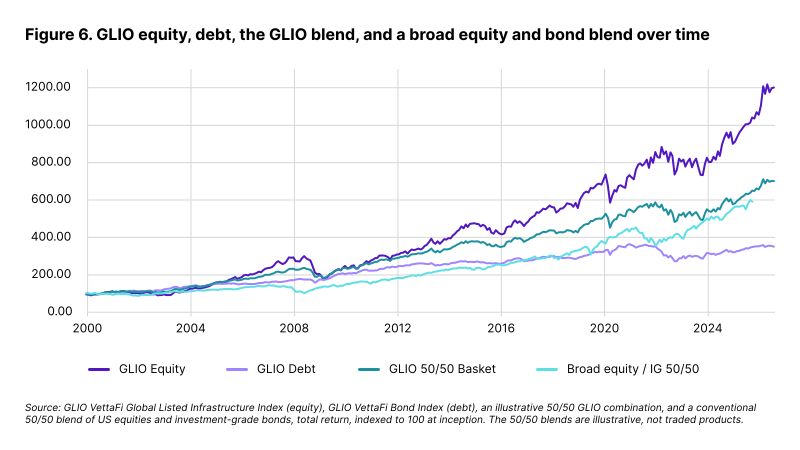
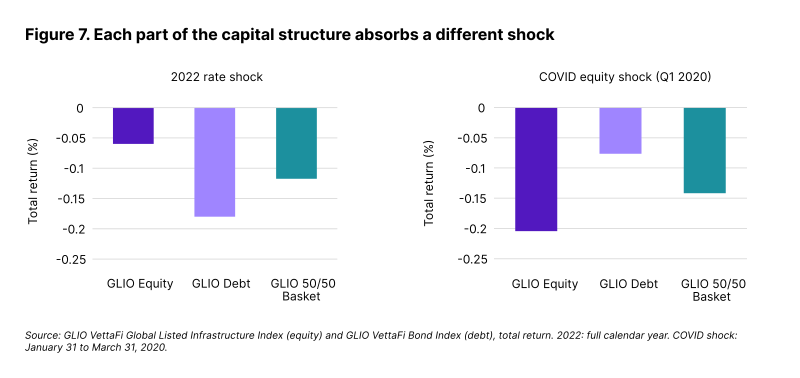
GLIO Debt and GLIO Equity have had a monthly correlation of 0.54, reflecting exposure to the same broad theme without moving in lockstep. That distinction has shown up when it mattered most. In the 2022 rate-driven selloff, infrastructure debt was hit harder as yields rose sharply, while infrastructure equity was more resilient. During the COVID-driven equity drawdown in early 2020, the pattern reversed, with equity absorbing the larger shock and debt proving more defensive.
This is the core portfolio case. A combined allocation to infrastructure debt and infrastructure equity does not simply average the two exposures. It creates a more balanced infrastructure profile, pairing the income and seniority of credit with the growth potential of equity. Over the full period, a 50/50 GLIO Debt and GLIO Equity blend delivered stronger risk-adjusted results than either standalone exposure and compared favorably with a conventional 50/50 blend of US equities and investment-grade bonds. The infrastructure blend produced a higher Sharpe ratio and a shallower maximum drawdown.
| Index / allocation | Annualized return | Sharpe ratio | Max drawdown |
| GLIO 50/50 Basket | 7.8% | 0.66 | -22.7% |
| GLIO Equity | 10.1% | 0.62 | -38.1% |
| Broad equity / IG 50/50 | 6.9% | 0.56 | -29.2% |
| GLIO Debt | 5.1% | 0.48 | -21.0% |
Source: GLIO VettaFi Global Listed Infrastructure Index (equity), GLIO VettaFi Bond Index (debt), and conventional 50/50 blend of US equities and investment-grade bonds, total return. The 50/50 blends are illustrative, not traded product.
For cross-asset investors, the conclusion is straightforward. Infrastructure is not only an equity allocation or a credit allocation. It can be owned across the capital structure, with debt and equity each contributing a distinct source of return, risk, and resilience.
Conclusion: Hard assets, high-grade credit
Broad corporate indices embed infrastructure exposure, but dilute it across sectors with very different business models, asset lives, and credit risks. GLIO Debt makes infrastructure credit measurable on its own terms.
It is a focused, transparent, rules-based benchmark for infrastructure credit, concentrated mostly in investment-grade issuers backed by long-lived physical assets and durable cash flows. For allocators who want infrastructure as a deliberate position rather than an accident of diversification, GLIO Debt offers clean exposure to one of the most asset-intensive segments of public credit.
For those who already hold infrastructure equity, GLIO Debt can add balance within the theme. Debt and equity are different claims on the same underlying infrastructure base. Hard assets, high-grade credit.