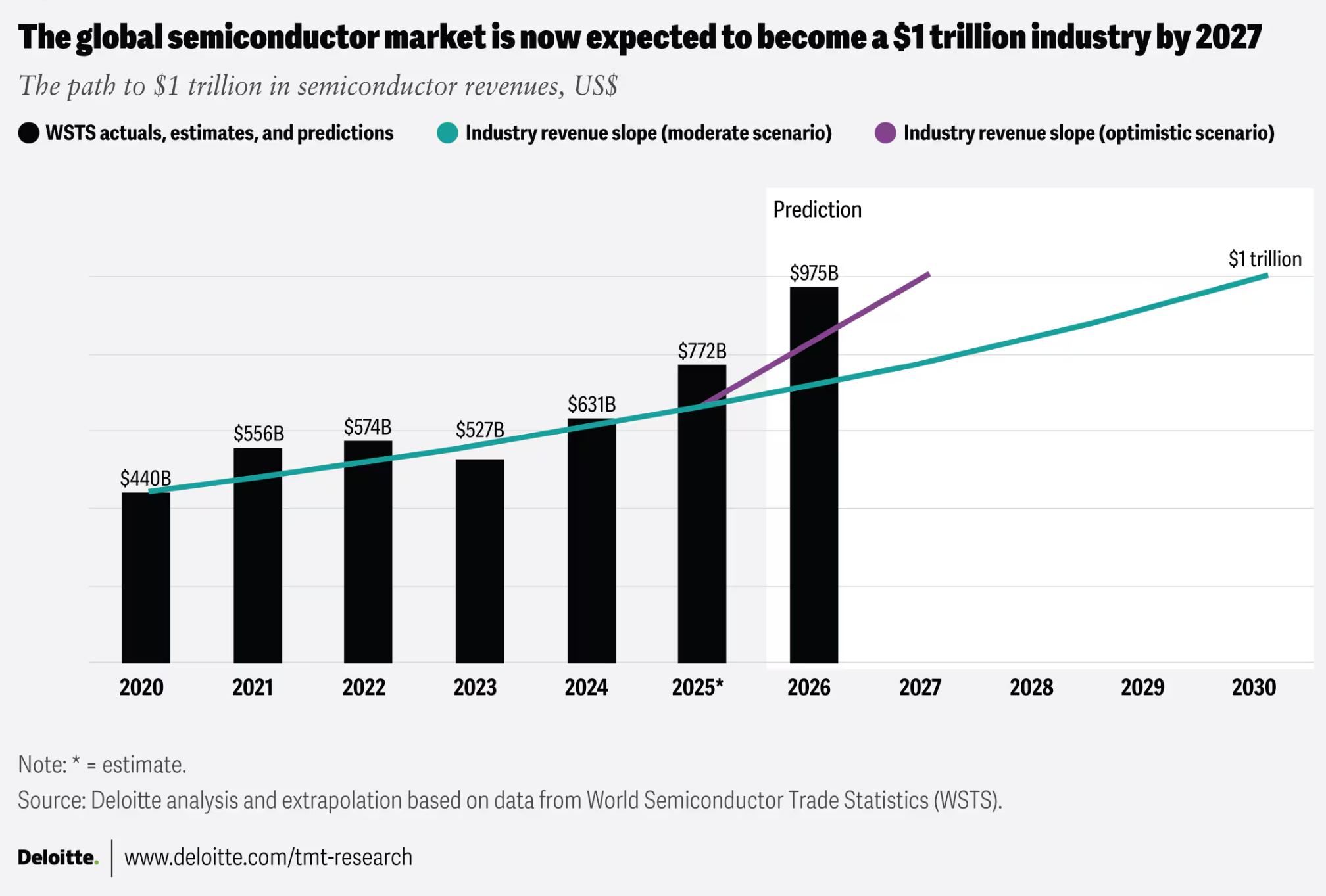
The International Semiconductor industry is experiencing historic growth driven largely by the boom in AI infrastructure demand. According to Deloitte, the global semiconductor industry is expected to reach $975 billion in annual revenue in 2026, representing a historical peak. It is expected to become a $1 trillion industry by next year.
Key Takeaways
-
The VettaFi International Semiconductor Index offers exposure to the top 25 non-US semiconductor and semiconductor equipment manufacturers.
-
International semiconductor holdings offer diversification, access to critical suppliers in the capacity-constrained global AI infrastructure supply chain, and attractive relative valuations compared to US peers.
-
Despite their mass appeal, most international semiconductor companies do not have US-listed ADR versions and are not easily accessible and tradable by US investors.
-
The Index, and the xETFs International Semiconductor ETF (ISMH) that tracks it, provides convenient access to a float market-cap-weighted basket of international semiconductor and equipment companies.
Diversification
The recent case of Nvidia, culminating in Jensen Huang’s resignation as CEO, makes a strong argument for international semiconductor diversification. Most US investors already have significant market cap-weighted exposure to Nvidia and other US semiconductor companies. As of November 11, 2026, the current weight to Nvidia is 6.8% (down from 7.7% at the end of Q3) The aggregate exposure to semiconductors and semiconductor equipment in the VettaFi 500 index was 14.8%.
Monopolies and Oligopolies With No US Equivalent
In addition to diversifying risk, many key non-US companies provide critical exposure to the AI and technology stack with no US equivalent. Indeed, many of these companies hold monopolistic and oligopolistic market positions, controlling essential layers of the semiconductor chip production process. These companies include:
-
ASML Holding (Netherlands): Holds a global monopoly position for Extreme Ultraviolet (EUV) and High-NA EUV systems for next-generation AI chips.
-
TSMC (Taiwan): Operates as the world's largest pure-play foundry, manufacturing over 90% of sub-10nm advanced logic and AI chips for firms like Nvidia, Apple, and AMD.
-
SK Hynix & Samsung (South Korea): Leading global producers of high-bandwidth memory (HBM) and memory modules essential for AI data center servers.
Helping to Ease Global Capacity Constraints
As rapid expansion among global hyperscalers and data centers strains worldwide capacity, international semiconductor and equipment manufacturers play an increasingly critical role in supporting the global supply chain. Key international suppliers are seeing record order bookings and multi-year backlogs.
Attractive Relative Valuations
Despite their favorable growth characteristics, non-U.S. semiconductor leaders trade at more reasonable valuation multiples than their heavily crowded U.S. megacap tech peers. Comparing the VettaFi International Semiconductor Index, which tracks the top 25 non-US listed semiconductor companies, vs. the MVIS US Listed Semiconductor 25 Index, relative valuation metrics appear more favorable for non-US companies.
| VISMHX | MVSMH | |
| Trailing Price/Earnings | 31.80 | 31.76 |
| Forward Price/Earnings | 20.37 | 22.33 |
| Trailing EV/Sales | 8.28 | 10.94 |
| Forward EV/Sales | 5.58 | 7.87 |
Source: VettaFi, as of 11/11/26.
Risk Factors to Consider
Despite its favorable diversification, growth, and fundamental characteristics, international semiconductor exposure is not without its risks. The top 25 international semiconductor and capital equipment companies have a high geographic concentration in East Asia (Taiwan, South Korea, and China), which leaves them vulnerable to trade tensions and geopolitical risks. With respect to China specifically, US-China export controls create short-term challenges. However, they simultaneously catalyze domestic expansion as the country moves to secure its own manufacturing capabilities.
Our Index Approach
The VettaFi International Semiconductor Index (VISMHX) is composed of the top 25 Global ex-US companies engaging in semiconductor or semiconductor-related business. The index is ranked by full company market capitalization and then weighted by float market capitalization. To be eligible for inclusion, companies must engage in semiconductor or semiconductor-related businesses and derive at least 50% of their revenues from semiconductor business or rank in the top 5 by market share with at least 25% semiconductor business revenue, subject to liquidity constraints. For more information about the index methodology, click here. We are proud to partner with xETFs on the xETFs International Semiconductor Index ETF (ISMH), which tracks this index and is scheduled to launch on November 20, 2026.


