Key Points
-
“Passive” market-cap-weighted index funds are not as neutral as they seem and often embed hidden costs within their stock-selection mechanism, paying a premium for recent winners and selling recent losers at a discount.
-
Cap weighting’s shortcomings can be ameliorated and its benefits maximized through simple tweaks to index construction, by, for example, smoothing market capitalization through five-year averages and aligning index eligibility with fundamental metrics of business scale, such as sales and book value.
-
Augmenting stock-selection methodology with banding and seasoning rules, fundamental metric considerations, and smoothed market capitalization may result in higher returns and lower turnover, while preserving transparency and market cap-weighting’s rules-based construction.
Contributor: Lillian Wu
This article is the first installment in a three-part series adapted from “The Active Side of Indexing,” our 2026 contribution to the CFA Institute Research Foundation.
Ask any investor what “passive investing” means, and they’ll give a familiar answer: low cost, broad diversification, no stock picking, no timing – just own the market. It is a compelling story, but it is wrong at the margins where trading takes place. Index funds are designed to be passive, yet their behavior is shaped by a set of rules that guide trading activity. At every rebalance, they move capital according to benchmark construction, often increasing exposure to stocks that have risen sharply, often for a very long time, and reducing exposure to those that have recently declined.
This dynamic is not driven by fundamentals, past or prospective. It is embedded in the structure of cap-weighted indexing. Because prices determine both stock weights in the index and, to a large extent, index membership, portfolios evolve in response to past price movements. What appears to be a neutral, rules-based strategy therefore contains a consistent and predictable pattern of trading – one that is easy to overlook but central to how returns are ultimately realized.
These effects are most visible in the relatively small portion of the portfolio that turns over each year. While index funds may only trade a modest share of their holdings, that activity is where implementation matters most. It is also where hidden costs arise and accumulate over time. These costs do not appear in expense ratios or in performance versus benchmark because the index is its own benchmark. Understanding this distinction is essential. If passive investing is not as neutral as it appears, the question is not whether it serves its intended purpose, but whether it can be improved. We believe it can.
From Representation to Participation
Indexes were originally designed to measure markets, not to influence them. Their purpose was representation, not participation. That purpose has irrevocably changed.
Indexes were originally designed to measure markets, not to influence them. Their purpose was representation, not participation. That purpose has irrevocably changed.
As indexing evolved from measurement to investment, the act of replication began to influence the market itself. With trillions of dollars tracking major benchmarks, index changes now generate large and predictable trading flows. For example, S&P index-tracking strategies now own roughly 25% of the market cap of all members of the index. Additions attract enormous demand, amounting to 25% of the company’s value mostly trading in a single day, blissfully indifferent to underlying company fundamentals; deletions trigger similarly immense selling, at least relative to the diminished value of these deletions. Markets anticipate these flows, and prices adjust materially before the index reconstitution takes effect, which is when index funds generally trade. This creates a self-reinforcing loop: Price moves alter index weights, those changes trigger forced trading, and that trading pushes prices further still.
The Illusion of “Costless Investing”
Indexing is often viewed as nearly costless. Fees are low, and turnover is modest. But costs are not limited to fees. Every rebalance requires trading, often under crowded and predictable conditions. Empirical evidence shows that stocks added to major indexes tend to experience price run-ups prior to inclusion and underperform afterward, while deletions tumble before their removal from the index but then often rebound. These patterns impose real costs on index investors – costs that do not show up in expense ratios. What appears to be a low-cost strategy in terms of fees may carry hidden costs in implementation. An analysis of the index reconstitution effects of S&P 500 additions and deletions between 1989 and 2017 quantified the performance erosion at about 25 basis points (bps) per year. These hidden costs are not terribly large, but in an industry where 1-bp fee differences often drive immense capital flows, they matter far more than the fees.
Indexing is often viewed as nearly costless. Fees are low, and turnover is modest. But costs are not limited to fees. Every rebalance requires trading, often under crowded and predictable conditions.
Tracking Precision and Its Trade-Offs
Modern index construction has made these dynamics more pronounced. Changes are now announced in advance, allowing funds to align closely with their benchmarks, to a near-100% match. But precision comes with a trade-off.
Index funds are judged on tracking precision, not their ability to add value, because many index fund investors presume that any added value was pure luck, a consequence that may arise from sloppy trading. The safest business strategy for an index fund may be to trade at the moment the index changes, regardless of price. The trade is called a market-on-close (MOC) order. Done correctly, this eliminates visible deviation but locks in hidden costs. The more precisely a fund tracks its index, the more reliably it captures these hidden costs. The paradox is clear: Trading appears costless because tracking error is minimal, yet the underlying costs are real and persistent, and may even be maximized by the quest for zero tracking error.
A Structural Bias: Buying High, Selling Low
At the heart of cap-weighted indexing lies a simple but powerful mechanism: Portfolio weights – and, in many cases, index membership itself – are determined by market prices. As prices rise, stocks gain weight and, in some cases, enter the index; as prices fall, weights decline and stocks may exit. Because price reflects past performance, this process systematically allocates more capital to recent winners and less to recent losers. On the edges, where the trading occurs, this translates into a recurring pattern: buy what recently worked, after it’s already risen, and sell what recently failed, after its price has fallen.
This relationship is inherent in the design. Over time, it creates a subtle but persistent return drag: Gains are often realized before a stock is added to an index, while losses are often locked in by removal of the stock.
It also helps explain the hidden costs. When index changes follow price movements, trading can become predictable and amply anticipated. What appears to be passive exposure is, in practice, shaped by a systematic, momentum-driven migration process. If these effects arise from how indexes respond to price, then improving outcomes does not require abandoning indexing; it requires rethinking how those rules are defined.
Beyond Cap-Weighting: Rethinking Index Construction
For better index construction, forecasts, discretionary judgment, or complex optimization are unnecessary. In fact, many of the most effective improvements come from simple, intuitive adjustments – changes that preserve transparency and rules-based construction while reducing the unintended consequences of cap-weighting.
If these structural biases are due to how indexes are built, the natural next step is to ask whether those design choices can be enhanced. In practice, however, they are the result of a selection process – whether rules-based or committee-driven – that determines which companies qualify for inclusion. Once selected, those companies are weighted by market capitalization, but the selection step itself plays a critical role in shaping outcomes.
If index membership is a function of recent market capitalization, then inclusion tends to follow strong price performance, while exclusion follows extended underperformance. In this sense, the selection process itself inherits the same structural flaw as cap-weighting: It favors recent winners and discards recent losers. This raises a natural question: Can we improve index outcomes not by changing how we weight stocks but by improving how we select them?
Can we improve index outcomes not by changing how we weight stocks but by improving how we select them?
Simple Alternatives to Traditional Selection
Several straightforward modifications may improve index construction while preserving the familiar structure of cap-weighted portfolios. One approach is to base selection on smoothed market capitalization, such as a multi-year average. This seeks to reduce the influence of short-term price swings and avoid promoting companies into the index based on temporary surges. Another method is to define eligibility using measures of business scale, such as sales, cash flow, or book value. These metrics evolve more gradually than market prices and aim to provide a more stable foundation for determining which companies represent the investable opportunity set. In effect, we would wait for growth in a company’s fundamentals to validate a price move that likely preceded the business success. We may come late to the game, but we believe this approach will have far fewer costly flip-flops.
Additional refinements such as banding rules and seasoning requirements can further reduce unnecessary turnover by preventing small, transient changes in ranking from triggering index additions or deletions. None of these changes alter how stocks are weighted. They simply improve which stocks are chosen to be in the index.
These ideas are easy to describe. The more central question is whether they matter in practice. To answer this, we simulated six simple 500-stock portfolios and compared them to the S&P 500. Each portfolio keeps cap-weighting intact but alters how companies enter and exit. These rules may look like small tweaks, yet the long-term consequences are meaningful.
-
Top 500 by Market Cap selects the 500 largest U.S. companies each year based on current market capitalization.
-
Top 500 by Five-Year Average Market Cap ranks companies by their average market cap over the past five years, selecting the top 500.
-
Top 500 by Fundamental Size: Selects the 500 largest firms using a composite of fundamentals: book value (plus intangibles), five-year average sales, five-year average cash flow, and five-year average dividends (plus buybacks).
-
Top 500 by Market Cap, with Banding & Seasoning applies a 20% buffer around the cutoff, so that borderline names do not bounce in and out, and a seasoning rule requiring two consecutive years of qualification before entry or exit.
-
Top 500 by Five-Year Average Market Cap, with Banding & Seasoning combines the smoothing benefits of multi-year averaging with the stability of banding and seasoning.
-
Top 500 by Fundamental Size, with Banding & Seasoning applies the same stability rules to the fundamentals-based selection.
The following table (Exhibit 1) summarizes the results.
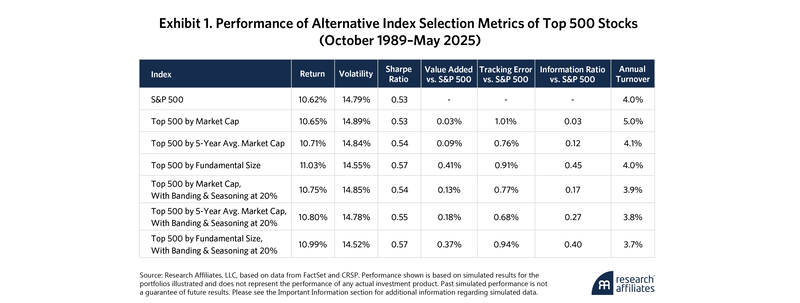
"Top 500 by Market Cap" provides an interesting counterpoint to the well-known S&P 500. Selecting the 500 largest U.S. companies by market value each year delivers a modest 3 bps of excess return relative to the S&P 500, but with slightly higher turnover and higher risk, and with a tracking error of 1%. Is the tracking error a consequence of active management? No, it’s the other way around: The S&P 500 is managed by committee, not simple rules like market value. This underscores a key point: The S&P 500 is not, as is too widely believed, a pure "top 500 by size" portfolio.
"Top 500 by Five-Year Average Market Cap" takes a longer view of company size. This reduces its sensitivity to short-term price fluctuations and results in more stable index membership. It delivers roughly 9 bps of annual excess return while maintaining turnover levels close to the S&P 500 and well below those of a naïve market-cap strategy.
Selecting companies based on fundamental size delivers the strongest outcome. Using fundamental metrics such as sales, cash flow, book value, and dividends to define the top 500 produces an annual return advantage of 41 bps, with no increase in turnover. Tying inclusion to underlying business activity rather than recent price movements can avoid many of the innate inefficiencies of traditional selection.
Further gains come from refining how changes are implemented. Banding and seasoning rules filter out marginal rank changes and require persistence before entry or exit. Applied consistently, these rules reduce turnover from 5.0% to 3.9% in the market-cap-based approach, without altering the overall structure of the portfolio.
Across all variations, risk characteristics remain remarkably stable. Volatility and tracking error differ only slightly, indicating that these adjustments primarily affect efficiency and turnover rather than overall market exposure. Taken together, the evidence is clear: Small changes in how index constituents are selected can boost returns without changing how the portfolio is weighted.
To better understand what drives the performance differences, we examine the six portfolios through the lens of the Carhart four-factor model, which adds momentum to the Fama-French three-factor framework. Exhibit 2 reports annualized alphas alongside loadings on the market, size, value, and momentum factors.
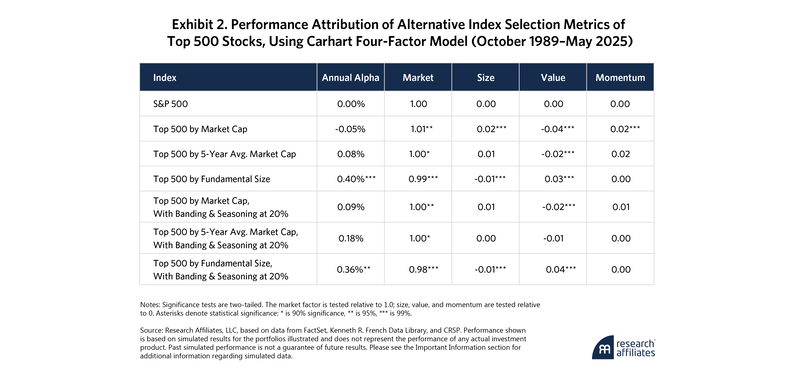
The results confirm what intuition suggests. Strategies that continue to anchor selection on market capitalization – whether using point-in-time values, multi-year averages, or stability rules such as banding and seasoning – show little evidence of alpha after accounting for factor exposures. Their annualized alphas are all very close to zero. The simple "Top 500 by Market Cap" comes in slightly negative, at about –5 bps per year, while adding banding and seasoning nudges it just above zero, to 9 bps per year. "Top 500 by Five-Year Average Market Cap" generates a modest positive alpha of 8 bps per year, which rises to 18 bps with banding and seasoning. However, in all cases, these estimates are statistically indistinguishable from zero.
By contrast, the strategies that rely on fundamentals-based selection tell a different story. Both the "Top 500 by Fundamental Size" portfolio and its banded-and-seasoned version generate statistically significant alphas in the range of 36 to 40 bps per year. Importantly, these results are not driven by large differences in conventional factor exposures. These portfolios exhibit only a modest value tilt and otherwise maintain broadly similar risk characteristics.
This distinction is essential. Over much of the sample period, value has underperformed growth, so any value exposure would have been a headwind rather than a source of excess return. The observed alpha therefore does not arise from traditional factor tilts but from differences in how the portfolios are constructed. One interpretation is that fundamental metrics provide a more stable and economically relevant basis for selection. Another is that part of the excess return reflects structural effects not fully captured by the standard Carhart four-factor model. A more practical explanation may be that these strategies benefit simply from avoiding the crowded and predictable trading associated with index rebalancing.
All told, the data demonstrates that even small design choices at the index boundary have critical long-run consequences. Although the broad cap-weighted market index appears passive, its reconstitution process features a momentum-like bias. The seemingly small slice of turnover is more reminiscent of a hype-chasing trader’s behavior than a neutral rule set.
Our simulations suggest this outcome is not inevitable. Maintaining the weighting system with cap-weighted portfolios of 500 names, while modestly refining selection criteria and enforcing boundary stability, can lead to better results. Multi-year averaging reduces short-term noise, fundamental anchors prioritize durable business scale over transient market enthusiasm, and banding and seasoning limit unnecessary turnover. The result is straightforward: higher returns, lower turnover, and no material increase in risk.
Rethinking “Passive”
Indexing has earned its place as one of the most effective innovations in modern investing. Its advantages – low cost, broad diversification, and transparency – are real and enduring. But on the edges, where stocks are bought and sold, index funds are not neutral. Even within a fully rules-based, cap-weighted framework, the choices ingrained in index construction shape outcomes in meaningful ways. How companies are selected, how changes are implemented, and how stability is maintained all influence returns, turnover, and the path investors experience over time.
Index funds are passive in construction but not in consequence. The rules that define them can embed momentum, create predictable trading patterns, and introduce costs that, while easy to overlook, are persistent. These effects are most visible at the margin – where trading occurs, and where results are quietly determined. Recognizing that indexing has an active side is not a critique. It is a starting point.
Index funds are passive in construction but not in consequence. The rules that define them can embed momentum, create predictable trading patterns, and introduce costs that, while easy to overlook are persistent.
The success of indexing has been built on clarity, transparency, and discipline. Those principles remain in force. As indexing continues to grow, so does its influence on markets. The question is no longer whether passive investing works – but how it can be built more thoughtfully. By refining how indexes are constructed, without changing their fundamental structure, what has made indexing successful can be preserved while the features that unduly influence results over time are addressed. Strengthening index funds begins with this simple truism: Passive investing can never be entirely passive.


