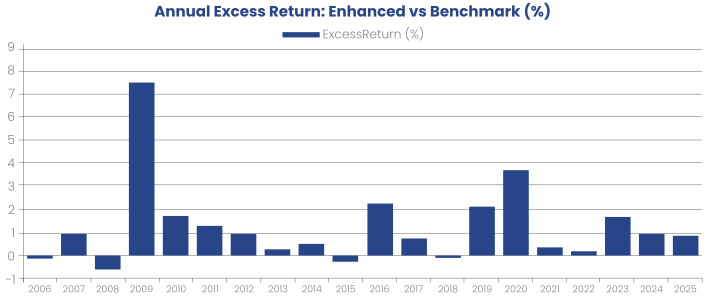
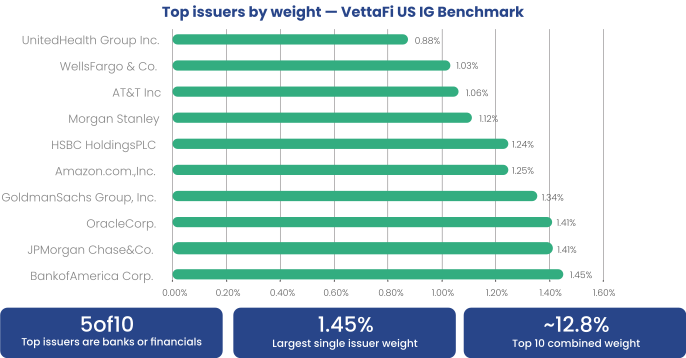
There is a long-standing critique of passive fixed income investing that deserves a direct response. Bond indices, the argument goes, are structurally flawed because they allocate more capital to the largest borrowers – regardless of capital structure discipline or deteriorating credit quality. It is a fair observation about traditional index construction. But it is no longer a reason to dismiss passive investing.
The real question today is not whether to index – but how to index intelligently. A new generation of index design fixed income indexing has, until recently, largely replicated the market capitalisation framework borrowed from equities. This is now changing and the new generation of fixed income indices are designed to not merely track the market, but to express it more intelligently.
A new generation of index design
Equal-weighted construction is the initial and most important update. By allocating equally across a defined issuer universe, the index removes the debt issuance bias entirely while preserving the transparency and rules-based discipline that indexing offers. Critically, the equal-weight framework is designed to be duration and sector neutral relative to the broad benchmark –ensuring that any subsequent performance difference reflects deliberate exposure, not unintended rate or sector risk.
Equal weighting is the foundation. The more powerful development is the systematic application of factor tilts – the ability to harvest well-documented risk premia without discretionary judgment or active management fees.
Consistently underutilized premia
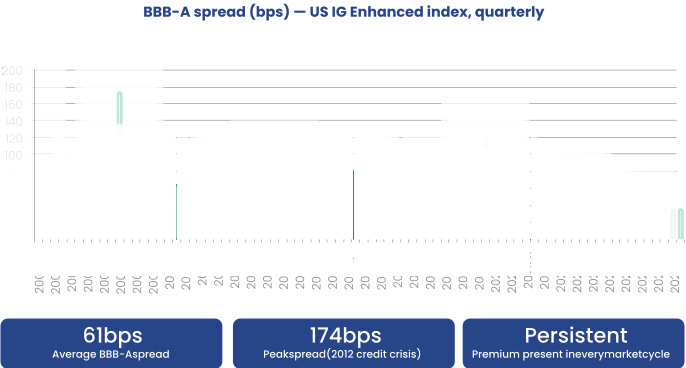
One of the most consistent premia in investment grade credit is the spread between BBB and single-A rated bonds. The BBB-A spread has been positive in almost every month since 2006. Within investment grade, where default rates remain low across the ratings spectrum, this premium has historically been adequate compensation for undertaking incremental risk.
Putting the hypothesis to work
The VettaFi Enhanced Yield US IG Index was built to validate this hypothesis. On an equal weight foundation of 200 issuers, the index applies a duration-constrained yield optimisation that tilts toward BBB-rated credits in a risk controlled manner – capping duration deviation and sector drift relative to the benchmark. The index rebalances monthly, with the eligible issuer universe reviewed and refreshed on an annual basis – providing stability in construction while remaining responsive to yield dynamics as they evolve through the credit cycle.
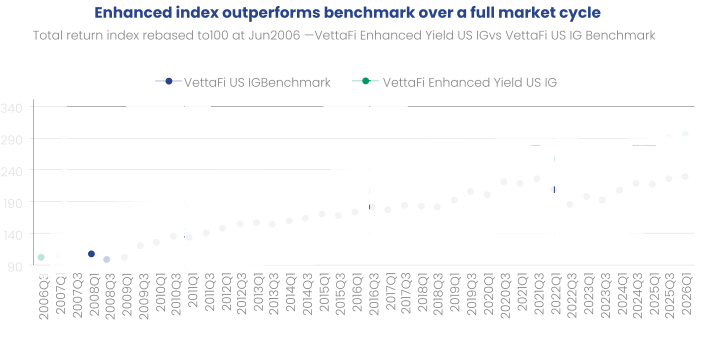
Since inception in July 2006, the index has delivered an average yield pickup of +34 basis points above a traditional market-cap weighted IG benchmark. Cumulative return since inception is approximately 198% versus 136% for the benchmark – annualised outperformance of approximately 121 basis points.
In years following credit dislocation – 2009, 2016, 2019, 2020 – the outperformance is considerably larger as BBB spreads compress and the index captures the recovery more fully than a benchmark concentrated in higher-rated, lower-yielding credits.
The broader implication
Passive investing in fixed income is often framed as a trade-off: accept the limitations of market-value weighting or move into active management. That trade-off is increasingly outdated. The idea that passive investing inevitably means allocating to the most indebted issuers is a myth rooted in legacy construction methods.
An equal weighted, enhanced yield index is one expression of what is possible – the fixed income index landscape is ripe for innovation and there is a lot more to come.