Introducing the VettaFi Humanoid Robot Select Markets Index
VettaFi is a thought leader in the area of robotics and automation thanks to its integration of the ROBO Global Suite of Indexes in 2023. The ROBO Global research team and strategic advisory board are specialists in the area of disruptive technologies such as robotics, artificial intelligence (AI), and healthcare technology. Humanoid robot technology represents the next innovative phase of robotics. Building on its research expertise in robotics, VettaFi recently developed the VettaFi Humanoid Robot Select Markets Index (VHUMS) which is licensed in Europe but is available for licensing in the U.S. and other markets.
Humanoid robots
As their name suggests, humanoid robots are robots designed with human shape and form. Their humanlike appearance is the stuff of science fiction, but there is also function in the human form. Similar to humans, humanoid robots have humanlike parts such as heads, torsos, arms, and legs and are designed to be “bipedal” — walking on two legs.
While today’s humanoid robots are limited in task, their AI-powered brains are designed to work alongside humans to augment productivity and perform rudimentary tasks such as:
- Grasping an object
- Moving a container
- Opening packages
Those that attended VettaFi’s Exchange ETF Conference this year had the opportunity to meet and converse with Ameca the humanoid robot. Ameca serves as tangible, physical evidence of where AI, robotics, and energy/energy infrastructure investing can lead. Research and advisory firm Gartner estimates that by 2030, 80% of Americans will interact daily with autonomous, AI-enabled robots.
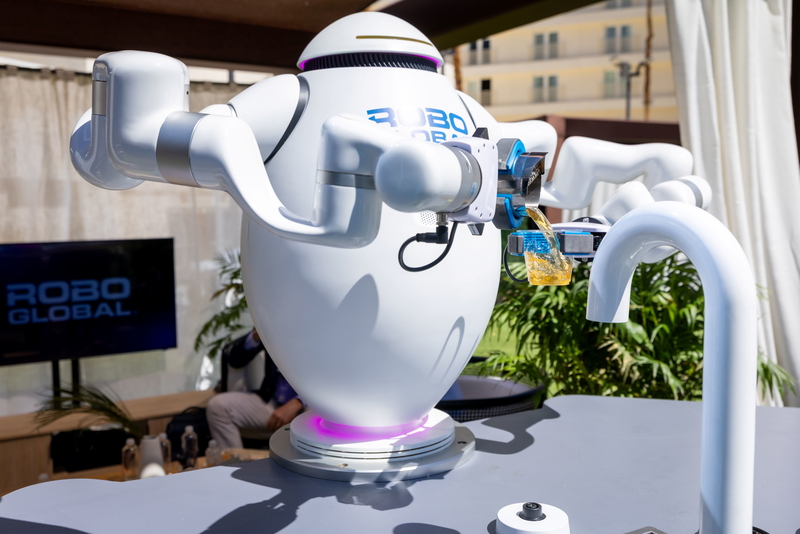
Humanoids are a $5 trillion market
According to a recent report by Morgan Stanley, by 2050, there could be as many as 1 billion humanoid robots in use, on track to become a $5 trillion market, including sales associated with the humanoid-robot-related supply chain, repair, maintenance, and support. The firm anticipates humanoid robot adoption will accelerate in the late 2030s thanks to technological improvements and greater regulatory and societal acceptance.
While today’s humanoid robots are quite pricey, with an estimated cost in 2024 of about $200,000 per humanoid, as technology improves and production scales, prices will come down. Morgan Stanley expects costs of $150,000 by 2028 and $50,000 by 2050. But low-cost humanoid robots may be coming sooner than that. Chinese firm Unitree just announced a $5,900 humanoid robot model R1 — a cheap, ultra-lightweight, customizable humanoid robot that stands 1.21 meters tall and weighs only 25 kg. It may lack “dexterity hands,” but it can do a cartwheel. Unitree Robotics is likely to IPO as a Chinese listing later this year on the Shanghai Stock Exchange.
Giving people superpowers
Professor Daniela Rus leads MIT’s Computer Science and Artificial Intelligence Lab and serves on ROBO Global’s strategic advisory board. She frames AI and robotics as giving people superpowers. “With AI, we get cognitive superpowers such as speed, knowledge, insight, creativity, and foresight. On the physical side, robots can extend our reach, refine our position, and amplify our strengths.” Rus and her MIT students have trained Ruby, a humanoid robot, to perform basic tasks in the kitchen. "We collect data from how humans do the tasks," Rus explains. "We are then able to teach machines how to do those tasks in a human-like fashion."
China at the forefront
At the 2025 World Robotics Conference held in Beijing last August, there were a record-breaking 50 humanoid robot manufacturers displaying their latest innovations. Popular demonstrations included UBTech’s showcasing of a fleet of humanoid robots sorting on a production line and Unitree’s live boxing performance. The event culminated in a “World Humanoid Games” competition where humanoid robot athletes competed in dance battles, martial arts, track and field events, and even soccer. China’s government has tagged humanoid robots as a “key future industry for the economy,” and has plans to build a world-class industry of humanoid robots by 2027. KPMG reports that China leads the world in humanoid robot patents, with nearly 6,000 filings in the past five years. Financial investment is flooding into the space, with 7.23 billion yuan (USD$1 billion) in 2024, up from 1.58 billion yuan (USD$220 Million) in 2020, representing a CAGR of 35.6%.
While it is too early to claim victory in the race for humanoid robot supremacy, the U.S. will need to make significant investments and commitments to remain competitive in this area. One prime example of U.S. innovation is Tesla’s Optimus, a humanoid robot designed for general purpose tasks that are dangerous or undesirable to humans, such as navigating harsh terrain. Another example is the Boston Dynamics Atlas Robot, which can perform amazing feats of agility, such as backflips and breakdancing.
Source: YouTube
VettaFi’s index approach
The VettaFi Humanoid Robot Select Market Index (VHUMS) is designed to provide investors exposure to the global companies driving the humanoid robotics industry. This includes developers of humanoid robots as well as providers of the essential components, semiconductors, and software systems that form the broader humanoid value chain
While humanoid robot technology is still in its early stages, the sector is poised for significant growth, driven by advancements in both hardware and AI software. Similar to automation robots, the manufacturing sector is expected to be the first to adopt this technology, performing dangerous, repetitive, or strenuous tasks, thereby improving safety, efficiency, and overall productivity.
The selection universe identifies global companies with thematic relevance to the Humanoid Robotics theme via designated revenue and thematic relevance. Thematic relevance is determined via a three-step scoring process.
- Screens for companies relevant to humanoid robotics, including but not limited to, robotics,artificial intelligence & software, semiconductors, and sensors.
- The identified list of companies is subjected to an AI-powered classification process to identify the companies engaged with the humanoid robotics sector.
- Only companies confirmed to have direct relevance to the humanoid robotics industry through at least one of the following universe segments are included in the universe.
Companies are required to have a minimum market cap of USD$500 million, a minimum three-month average daily traded value (ADTV) of $USD2 million, and a minimum free float of 20%. Unique market leadership developments in emerging themes are taken into consideration for the index weighting.
To learn more about this index and its licensing, click here.