Investors in gold miners and physical gold have been rewarded, given its “safe haven” status as a hedge against global uncertainty. Macroeconomic and geopolitical factors such as declining interest rates, rising fiscal deficits, tariff trade policies, and global geopolitical tensions have sparked concerns about “debasement” or the devaluation of fiat currency. The “debasement” trade has investors moving out of assets denominated in fiat currency and government debt into hard assets such as gold.
Physical gold on record run
Gold has outperformed core equity benchmarks since 2000 and provides diversification benefits as an asset class uncorrelated to stocks and bonds. On October 7, 2025, spot gold surpassed $4,000 per ounce for the first time, cementing its status as a top-performing asset class.
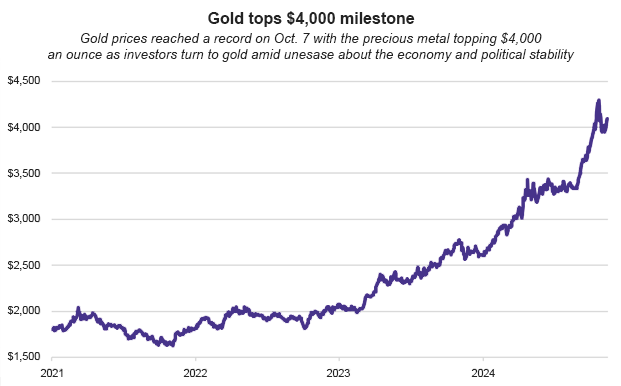
As of 11-November-2025; Source: Bloomberg
As seen in the graphic below from the World Gold Council, inflation, geopolitical risk assumptions, currency, interest rates, and price momentum have been key factors driving gold prices higher.
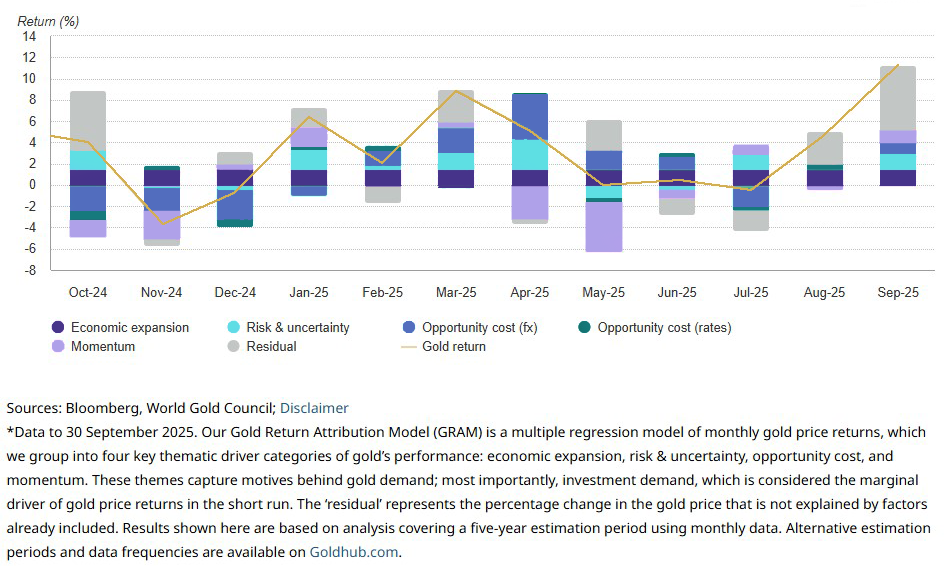
Data as of 30-September-2025; Source: Bloomberg, World Gold Council
Central banks are holding gold as currency hedge
Central banks, especially in emerging markets, are increasing their gold purchases to reduce their dependence on the U.S. dollar and hedge against currency depreciation.
For the first time since 1996, foreign central banks hold more gold than treasuries.
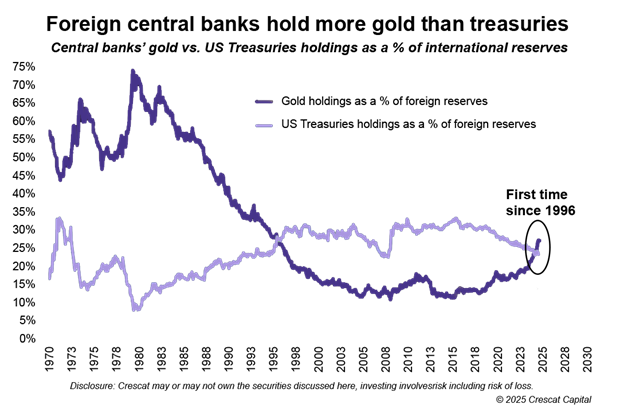
Data as of 27-August-2025; Source: Bloomberg; Crescat Capital; Tavi Costa.
Gold ETF inflows signal rising investor demand
Global physical-backed gold ETFs have experienced the strongest flows since the pandemic year of 2020. YTD through October 2025, $72 billion has flowed into physical gold ETFs, corresponding with the rise in gold prices. But most investors still remain underallocated to gold in their portfolios. Advice varies on how much investors should be allocating to gold. On the high end, Bridgewater’s Ray Dalio recommends as much as a 15% allocation to gold. Morgan Stanley favors a 60-20-20 model of equities, bonds, and gold. World Gold Council research excerpted below demonstrates that allocations between 4% and 15% in gold historically have improved risk-adjusted returns thanks to its low correlation with other asset classes.
Optimal gold allocation in a stock/bond portfolio, 1970-2024
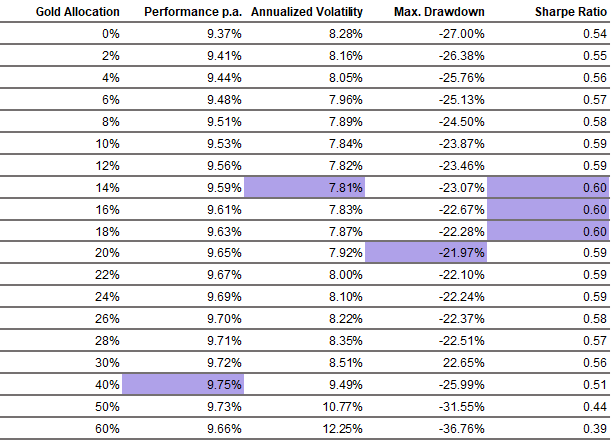
Source: Robert J. Shiller; Reuters Elkon; Incrementum AG
Gold miners a leveraged play on gold
Gold mining companies are often considered a “leveraged play” on gold prices, benefiting from fixed all-in sustaining costs (AISC) regardless of supply and demand. AISC covers a wide range of costs, including:
-
Exploration and study costs (sustaining): Expenditures necessary to sustain current operations, not for expansion.
-
Direct production costs: Labour, energy, consumables, and royalties.
-
Sustaining capital expenditures: Investments required to maintain production levels, such as equipment replacements and mine development
-
Administrative costs: Corporate overheads related to running the business.
-
Environmental and closure costs: Reclamation and mine closure provisions.
This “operating leverage” can result in profit margin expansion when gold prices rise. These elevated profit margins also translate into improved financial health, allowing miners to pay down debt, strengthen their balance sheets, or initiate or increase dividend payments to shareholders.
Learning from past boom and bust cycles, gold mining companies have made a strategic shift from chasing production growth to prioritizing financial value, including reducing debt, returning cash to shareholders, and maximizing shareholder value. Thanks to rising prices, cash flow generation is at record levels, coupled with strong earnings and reasonable valuations. YTD gold mining stocks have outperformed spot gold by a wide margin, given the favorable economics. Investors are seizing this opportunity, with inflows of $5.4 billion in Q3 2025, the largest quarterly inflow into gold mining funds since December 2009.
Gold miners outpacing physical gold YTD
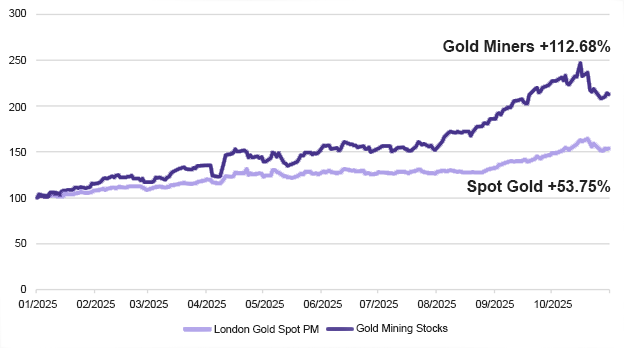
As of 31-October-2025, using NYSE ARCA Gold Miners; Source: Bloomberg
Our index approach
The VettaFi Gold Miners Screened Index (VGOLD30E) tracks the market performance of the largest 30 gold mining and royalty companies, including a position in The Royal Mint Responsibly Sourced Physical Gold ETC. Additionally, a negative screen is utilized to exclude companies with exposure to controversial and lethal weapons, thermal coal, and greater than 5% exposure to fossil fuels.
Universe:
CE Sub-Industry of Gold with an allocation to The Royal Mint Responsibly Sourced Physical Gold ETC.
Constituent Selection:
-
Minimum Size: Minimum market capitalization of 300 million USD, or 240 million USD for current constituents.
-
Minimum Free-float: Securities with free float of less than 20% are excluded.
-
Minimum Liquidity: Average daily traded value (ADTV) over the last three months of 3 million USD, or 2.4 million USD for current constituents.
-
Maximum # Names: 30 Constituents plus the ETC.
-
Minimum 3-month trading days: 22
-
Rebalanced Quarterly (Jan, Apr, Jul, Oct): Constituents are modified free-float market cap weighted at the time of rebalance.
Screening considerations:
ESG/Human Rights Filter: Constituent business operations must comply with United Nation Global Compact (UNGC) principles and the Organization for Economic Cooperation (OECD) Guidelines for Multinational Enterprises. Companies involved in the production, development, or maintenance of anti-personnel mines, biological or chemical weapons, cluster munitions or depleted uranium are excluded from consideration for the index. Additionally, companies must derive less than 5% of their revenue from fossil fuels, as well and not derive any revenue from the exploration, mining, or refining of thermal coal.
Categorized as an Article 8 fund under the EU Sustainable Finance Disclosure Regulation (SFDR).
Weighting:
Free float market capitalization weighted with equity component weights capped at 10% and the Royal Mint Responsibly Sourced Physical Gold ETC position set to 5% of the index.
Rebalancing:
Quarterly: March, June, September, December.
Royal Mint responsibly sourced physical gold (RMAU): 5% allocation
-
Responsibly sourced: All gold bars are certified to meet the LBMA's responsible sourcing guidelines, which have been in place since 2019.
-
Recycled gold: Over half of the gold backing the ETC is from 100% recycled sources, including surplus gold from The Royal Mint's own manufacturing processes.
-
Lower carbon footprint: Recycled gold is significantly less carbon-intensive than newly mined gold, making RMAU a more sustainable investment option.
-
Physical backing: The ETC is physically backed by gold bars, which are custodied at The Royal Mint's vault in Llantrisant, Wales, offering investors a direct link to physical gold.
-
Transparency and assurance: The ETC is independently audited to ensure compliance with its strict standards, providing an extra level of assurance for investors.
For more information about the VettaFi Gold Miners Screened Index, click here. To capture this opportunity in an investable product, the index has been licensed in Europe by HANetf as the Gold Miners Screened UCITS ETF (ESGO).