Key Points
-
Index “flip-flops” are hardly unusual. Many companies added to major indexes are later deleted, while a meaningful share of deletions eventually regain membership.
-
Flip-flops may expose a weakness in cap-weighted indexing. Companies often enter indexes after strong price gains and exit after prolonged declines, which can cause index investors to automatically buy high and sell low.
-
Flip-flop return patterns are highly asymmetric. Addition flip-flops typically underperform the market by two-thirds after inclusion, while deletion flip-flops often generate nearly three times the benchmark returns before rejoining an index.
-
We believe valuation matters more than index membership. Index inclusion is a backward-looking “prestige” moment, not a guarantee of future returns, while deletions may present opportunities rather than automatic sell signals.
Contributor: Lillian Wu
This article is the final installment in a three-part series adapted from “The Active Side of Indexing,” our 2026 contribution to the CFA Institute Research Foundation.
An index inclusion can feel like a coronation. A company enters the S&P 500 or Russell 1000 after years of price gains, growing market value, and glowing investor attention. The market has applauded. The index now makes the market’s judgment official.
In our world, however, such coronations are backward-looking: They celebrate prior success. By the time a company is large enough and popular enough to join a major benchmark, its price may already reflect its prior success. The index is more often recognizing a past winner than discovering a future one. Not every coronation endures. Some celebrated additions later lose their place in the index when the expectations that propelled them higher prove difficult to sustain.
An index deletion moves in the opposite direction. A company is removed following disappointment and fading investor enthusiasm. It resembles an exile rather than a newly crowned monarch. As we whimsically noted in “Nixed: The Upside of Getting Dumped,” some exiles go on to achieve great failure.1 Other deletions are temporary: Some exiles regain their past mojo and are eventually restored to the index that cast them out.
We call these membership reversals “flip-flops.” Flip-flops expose a practical weakness in cap-weighted indexing. At the margin, index membership can follow cycles of excitement and disillusionment rather than lasting business success. Investors – and the index funds that we all know and love – do not have to make the same mistake.
Flip-flops matter. They compress the index machine’s timing problem into one observable round trip: A company is added after enthusiasm and removed after disappointment, or deleted after pessimism and restored after recovery. The sequence is not random. It demonstrates how cap-weighted indexes respond to past price movements.
Flip-flops matter. They compress the index machine’s timing problem into one observable round trip: A company is added after enthusiasm and removed after disappointment, or deleted after pessimism and restored after recovery.
Modern indexes do more than measure markets. Trillions of dollars now track them directly, turning membership changes into market-moving events. The result is a systematic migration of capital toward recent winners and away from recent losers – not through discretionary forecasts or active judgment, but rather the expected market impact of index rules.
Most of the time, this process works reasonably well. Many successful companies remain successful for decades. But many do not. An analysis of flip-flops suggests that markets are noisier and their leadership less durable than cap-weighted indexing assumes. Added companies frequently struggle afterward, while many deletions later recover. The same price movements that drive index inclusion and expulsion can also amplify the risk of buying high and selling low.
The same price movements that drive index inclusion and expulsion can also amplify the risk of buying high and selling low.
The issue may not be that indexes occasionally “get it wrong,” but that cap-weighted reconstitution mechanically reinforces those swings by moving capital in response to price movements that have already occurred. Flip-flops simply bring this hidden dynamic into stark relief.
How Common Are Flip-Flops?
Flip-flops are not rare exceptions: They are surprisingly common. They are also expensive. We define an addition flip-flop as a company that is added to and subsequently removed from an index within 10 years. A flip-flop joins an index when its price reflects lofty expectations and is dropped when it fails to meet those expectations, at an average two-thirds loss. Companies can disappear from indexes through mergers, acquisitions, bankruptcies, or discretionary deletions. More than half of the stocks that survive more than a decade after their coronations are exiled in the next 10 years.
A deletion flip-flop moves in reverse: A sputtering company is deleted in the face of a bleak outlook but regains its footing and rejoins the index within a decade. On average, between deletion and readmission, such flip-flops generate nearly three times the market’s return.
Using the S&P 500 and Russell 1000 as case studies, Exhibit 1 shows how prevalent these membership reversals are, specifically how frequently deletions were added to an index during the prior decade and would return over the next decade. The S&P 500 and Russell 1000 represent two of the most common index construction methodologies, respectively, a committee-based methodology and a predominantly rules-based one.
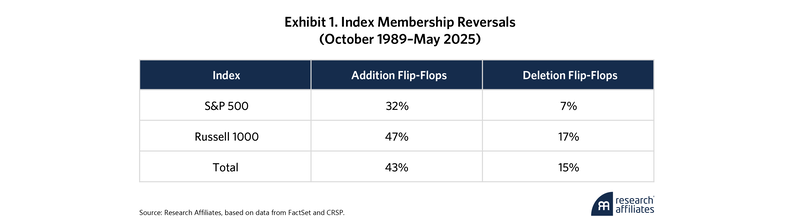
The results for addition flip-flops are particularly striking. Roughly one-third and one-half, respectively, of S&P 500 and Russell 1000 discretionary deletions had been added within the prior decade. Across both indexes, 43% of discretionary deletions were previously addition flip-flops.
Deletion flip-flops are less common. About 7% and 17% of S&P 500 and Russell 1000 deletions, respectively, rejoin the index within 10 years. Across both indexes, 15% of deletions eventually return from exile.2
These membership reversals add up. Across the S&P 500 and Russell 1000, we identify 606 addition flip-flops and 210 deletion flip-flops, or 816 total, over the October 1989 through May 2025 sample period. With its broader coverage universe, the Russell 1000 accounts for more cases, though the S&P 500’s share is still robust.
For investors, the message is clear: Index membership is not a permanent seal of approval but often a delayed response to price movement. Flip-flops show that indexes can change their minds – but only after investors have experienced the price swing.
Why is this important? Because flip-flops represent more than simple turnover. They reflect cap-weighting’s systematic impact on the hypothetical index investor’s bottom line.
To be sure, markets are constantly evolving and no indexing methodology can perfectly distinguish temporary enthusiasm from lasting business success. But flip-flops do raise a natural question: How are investors affected by these membership reversals?
Beware the Newly Crowned
Flip-flops rarely begin as obvious mistakes. At inclusion, most additions appear entirely justified. They are often among the market’s strongest performers, backed by compelling narratives, impressive growth, and widespread investor enthusiasm. Their rising market capitalizations earn them a place in the index precisely because they have become market leaders. The difficulty is simple: Market leadership is often more fragile than it appears.
Recent S&P 500 additions provide two striking examples. The pharmaceutical and biotechnology company Moderna joined the index in July 2021 after becoming one of the biggest beneficiaries of the COVID-19 pandemic. In the year preceding its inclusion, the stock outperformed the market by nearly 190%. It gained another 30% in the brief interval between announcement and implementation. With compounding, Moderna rose 280% before membership. But the enthusiasm was short-lived. As vaccine demand normalized and pandemic tailwinds faded, Moderna fell more than 40% relative to the market in the 12 months after its addition.
The information technology firm Supermicro experienced a similar trajectory. Fueled by extraordinary bullishness surrounding artificial intelligence (AI) infrastructure, the company surged more than 750% compared to the market before its March 2024 inclusion. Amid seemingly insatiable demand for AI servers, investors were willing to pay increasingly rich valuations for exposure to the theme. However, Supermicro surrendered much of those gains in its post-coronation year, falling more than 70% versus the market.
Neither example demonstrates that the index committee made a mistake: Both companies were market leaders and satisfied the membership requirements. Rather, they highlight a broader challenge inherent in price-driven index construction. Moderna and Supermicro were not bad companies. Their index inclusion simply came after their underlying narratives became expensive. Wonderful companies can be poor investments if their stories are overpriced.
This dynamic helps explain why flip-flops occur. The expectations that precede index inclusion can be hard to sustain. Subsequent returns may disappoint, sometimes severely. By the time a company joins an index, the optimism that powered its ascent may already be embedded in its share price.
The Cost of Buying the Coronation and Selling the Abdication
Moderna and Supermicro illustrate how market leadership can be more fleeting than investors expect. But these anecdotal cases tell only part of the story. A more important consideration is what consequences such membership reversals have for investors: How much do they cost? Exhibit 2 shows the average excess performance of S&P 500 and Russell 1000 flip-flops between their index entry and exit. To focus on clear flip-flops, we confine our analysis to cases in which both index events occurred during a 10-year span.
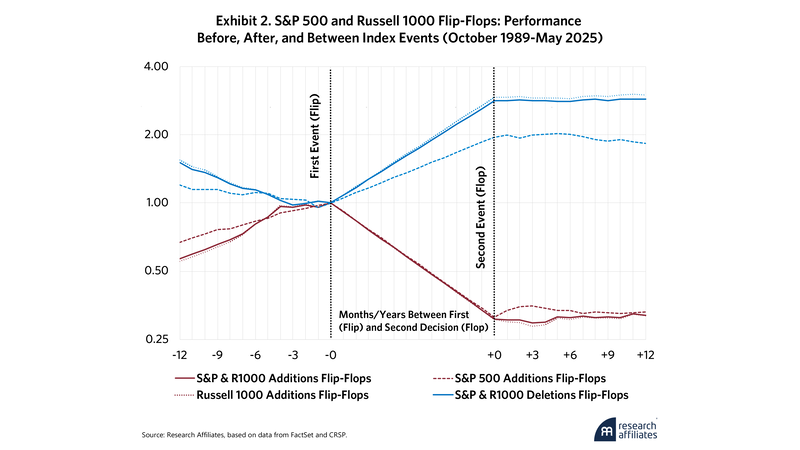
The return patterns are remarkably asymmetric. Addition flip-flops outperformed the market by roughly 75% in the run-up to their initial inclusion. Between addition (flip) and deletion (flop), stocks lagged the market by nearly 70%. Index fund investors thus missed out on the surge that led to the stock’s addition and then lost more than two-thirds of the wealth that was tied up in that flip-flop. They mechanically bought towards the top and sold near the bottom.
Deletion flip-flops followed the opposite trajectory. Before removal, they underperformed. Post-removal, many surged back to prominence, beating the market by nearly 200% en route to regaining membership. Deletion flip-flops delivered more than three times the returns of the corresponding index, on average, prior to returning from exile. Still, not every deleted company is a bargain, and some deletions are well deserved. But deletion should be a research trigger, not an automatic sell signal. The practical question ought to be straightforward: Is the business broken or is the stock merely unpopular?
The economic significance of these patterns extends beyond the short-term effects of index reconstitution announcements. The announcement-date impact of an index change is typically a few percentage points, while the performance swings associated with flip-flops often add up to tens or even hundreds of percentage points over many years. The cost arises not from a few days of trading around reconstitution but from index membership’s tendency to follow rather than anticipate market leadership changes.
Of course, all index methodologies are fallible. None can differentiate frothy sentiment from long-term value creation with 100% accuracy. The lesson is not that index providers routinely make mistakes, but that the prevalence and performance of flip-flops suggest that market capitalization can be a lagging indicator of a company’s economic footprint. By the time a stock warrants index inclusion, its share price may have nowhere to go but down. Likewise, by the time a company is exiled from an index, it may already be well into recovery.
Should Valuation Be the Referee?
Valuation is the referee because index membership alone cannot tell whether expectations are accurate. A company can deserve to be in the index and still be a poor investment if the price already assumes more success than is subsequently achieved. Likewise, a company can deserve to be deleted and still become interesting if the price ignores the possibility that success may return. The question is not whether the index decision was reasonable but whether the market has overpaid for the coronation or overcharged for the exile.
Flip-flops are not isolated mistakes or unfortunate timing decisions. Both S&P 500 and Russell 1000 flip-flops represent recurring features of index construction with remarkably consistent reversal-related return patterns. Companies that become addition flip-flops tend to enter the index after exceptional performance and elevated expectations. Those that become deletion flip-flops tend to leave after prolonged weakness and depressed expectations.
Index investors experience this cycle in two ways: They participate in the two-thirds loss of relative value that accompanies addition flip-flops and miss the tripling of relative value associated with deletion flip-flops. That’s huge. If turnover was not so low, the cost would be much larger than scores of basis points.
Index investors [. . .] participate in the two-thirds loss of relative value that accompanies addition flip-flops and miss the tripling of relative value associated with deletion flip-flops.
Index providers are not systematically choosing the wrong companies. Many additions become long-run success stories. Many deletions never regain their lost mojo. But flip-flops highlight market capitalization’s shortcomings as the primary determinant of index membership. Market prices incorporate both business fundamentals and investor expectations. When expectations become unusually optimistic or pessimistic, market capitalization can diverge materially from underlying economic scale. In those moments, a company’s index membership may more reflect market sentiment than business reality.
Viewed through this lens, flip-flops are not anomalies but visible manifestations of how cap-weighted indexes respond to market leadership after it has already emerged. The same process that adds companies after they succeed can remove them after they disappoint. Likewise, companies that recover post-deletion may only regain membership after much of their rebound has run its course.
Build Patience into the Portfolio
These observations do not invalidate indexing. Cap-weighted indexes remain among the most efficient investment tools ever created. Flip-flops, however, remind us that indexing is not neutral at the margin. Every index has rules, and those rules decide when capital moves from one company to another. The resulting trades buy high and sell low. That’s why patience is an important counterweight to the reconstitution process.
Investors may want to consider separating prestige from price. Index inclusion is prestige. It is a coronation, not a guarantee of future returns. Index deletion is an embarrassment, not proof of permanent failure.
That is why valuation is a useful arbiter. When a surging company enters a major index, investors should wait to celebrate. When a collapsing company falls out of an index, they should investigate rather than count it out. When building portfolios, investors should favor patience: seasoning, banding, valuation discipline, and business scale metrics that do not blindly chase every swing in market capitalization. Instead of applauding every coronation and mourning every exile, investors may want to ask whether expectations have gone too far.
End Notes
1. Arnott, Rob, and Forrest Henslee. 2024. “Nixed: The Upside of Getting Dumped.” Research Affiliates.
2. These percentages are, of course, higher when adjusted for companies that cease to exist due to corporate actions.


