- The nuclear energy universe spans from uranium mining to developers of advanced reactors to utilities generating electricity from nuclear reactors, with very different risk profiles across the value chain.
- Given the diversity of nuclear-related stocks, index construction is particularly important for investors looking to access the space through an ETF.
- Uranium mining can be volatile and comes with idiosyncratic risks.
Nuclear-related stocks have seen significant positive momentum this year. In addition to policy tailwinds, investors are recognizing the critical need for reliable, carbon-free power generation for years to come. Nuclear represents a compelling opportunity in that vein. Nuclear-focused ETFs have seen some of the strongest inflows within the broader energy complex over the past year.
For investors who are new to the nuclear space, it can be difficult to determine the best way to gain exposure. Investors may be considering uranium miners or direct uranium exposure, utilities operating nuclear plants, or the supporting companies involved in engineering and construction.
There are also several developers of small modular reactors (SMRs) with exciting potential but also execution risk. Clearly, there are different investment characteristics for a pre-revenue SMR developer like Oklo (OKLO) and a utility like Vistra Energy (VST). However, both are part of the nuclear power universe.
NUKZ: A thoughtful approach to nuclear
Given the diversity of the nuclear-related companies and their risk profiles, index construction is particularly important and requires distinct expertise. The Range Nuclear Renaissance Index (NUKZX) was designed with a focus on diversification and maximizing risk-adjusted returns. The global index includes four categories with specific weightings. Construction and Services is capped at 35%, followed by Advanced Reactor and Utilities at 30% each, and Fuel at 20%.
Caps for individual companies result in beneficial diversification. Pre-revenue and pure-play constituents are capped at 10%, while diversified names like Fluor (FLR) and Dominion Energy (D) are capped at 3%. The index currently has 44 constituents, as shown in the infographic below.
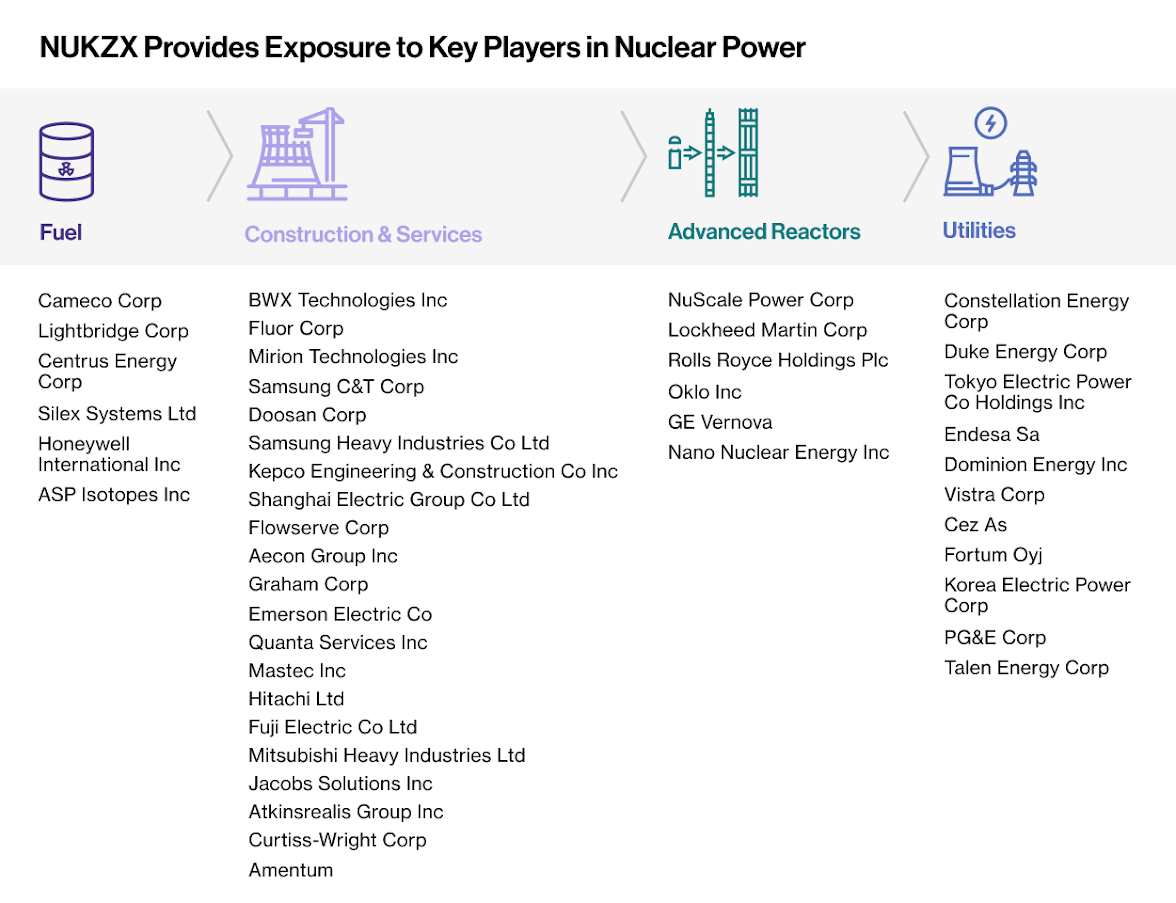
By design, the index includes the exciting developments in advanced reactors, including SMRs, without being overexposed to one company or one technology. The pre-revenue, more speculative companies are balanced by the steadier exposure to construction and services and utilities. Utilities have historically been known for their defensive characteristics.
Why uranium mining isn’t featured.
Notably missing from the diagram above is uranium mining. Uranium miners have typically been more volatile due to missed production estimates or geopolitical issues. One example is companies mining uranium in Niger and challenges resulting from a coup d’etat in 2023. Uranium miners also tend to be known for dilutive equity raises.
The Fuel category was intentionally capped at 20% to limit exposure to the idiosyncratic risks associated with uranium mining. Companies in the index tend to be more focused on uranium enrichment or conversion. Cameco (CCJ) stands out for having exploration and mining, but its business is uniquely integrated and includes a 49% interest in Westinghouse. The remaining fuel companies are not involved in mining.
Bottom line
The breadth of nuclear participants and their distinct risk profiles requires thoughtful index construction. The NUKZX index was developed with a focus on both diversification and maximizing risk-adjusted returns.
NUKZX is the underlying index for the Range Nuclear Renaissance Index ETF (NUKZ).
This article was originally published October 27th, 2025 on ETF Trends.